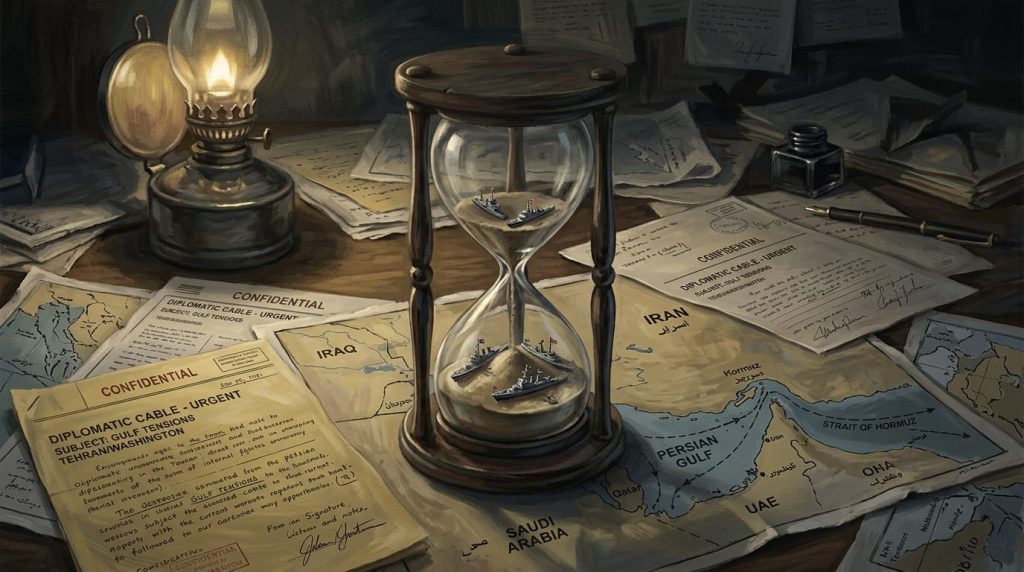
The Trump Iran truce appears less a breakthrough than a calculated pause. Beneath the language of peace lies a strategy built on pressure, deadlines, and leverage over the Strait of Hormuz. This moment reveals not resolution, but the limits of coercive diplomacy and the fragile nature of temporary geopolitical stability.
On the evening of April 7, 2026, with less than two hours remaining before his self-imposed deadline to launch what he had described as the most devastating bombing campaign in American history, Donald Trump posted a message on Truth Social that effectively halted a war. Hours after threatening that “a whole civilisation will die tonight,” Trump reversed course, crediting Pakistan for mediating a settlement and announcing a two-week suspension of military strikes contingent on Iran agreeing to the “complete, immediate, and safe opening” of the Strait of Hormuz. Both Washington and Tehran declared victory. Both were, in different ways, telling the truth, and that contradiction is precisely the point.
The Pakistan-brokered truce of April 7 was not a ceasefire in any conventional sense. It was a pressure tactic dressed in the language of peace: a short deadline, a single non-negotiable condition, and a theatrical announcement designed to extract a rapid Iranian concession on the world’s most consequential maritime chokepoint while buying time for negotiations whose outcome remains deeply uncertain.
Understanding why requires examining not just what was agreed, but what was not and placing this episode within the broader pattern of Trump’s diplomacy, which consistently prioritises the dramatic announcement over the durable settlement.
Contents
The Strait of Hormuz as Leverage
Any analysis of this truce must begin with the Strait of Hormuz, because the strait was not merely one issue among several. It was the entire architecture of Trump’s coercive strategy. Shortly after the war erupted, Iran moved to choke off traffic in the strait, a waterway through which nearly 20 per cent of the world’s oil and natural gas travels. This caused gasoline prices to skyrocket worldwide, including in the United States, where Trump faced domestic criticism from his own conservative base. The economic pressure on the American president was, paradoxically, as acute as the pressure on Tehran, which is why the reopening of Hormuz became the one condition Trump refused to give in on.
By making Hormuz the singular, explicit, and non-negotiable demand embedded in the truce announcement, Trump did something strategically clever: he compressed a complex geopolitical dispute into a single, binary test. Iran either opened the Strait or it did not. The narrowness of this framing lent credibility to Trump’s deadline and clarity to the truce. Secretary of State Marco Rubio had called Iran’s control over Hormuz “a big problem for the world,” and U.S. officials made clear that any agreement with Iran would have to produce near-immediate progress on that front. The strait was not a bargaining chip; it was the floor below which no deal could be struck.
Yet Iran’s response immediately revealed that the floor was contested. Iranian Foreign Minister Araghchi confirmed that Iran would allow “safe passage” through the Strait of Hormuz during the two-week period, but specified that this would be “via coordination with Iran’s Armed Forces and with due consideration of technical limitations.” The United States wanted the strait open, free, and unconditional. Iran was offering a managed, supervised corridor that preserved its sovereign authority over the waterway. These are not the same thing, and the gap between them encapsulates why the truce is better understood as a pause than a resolution.
Pakistan’s Role as Essential Broker
The truce could not have happened without Pakistan, and not merely because Islamabad happened to make a timely phone call. Pakistan’s mediation was structurally necessary because neither the United States nor Iran possessed a direct diplomatic channel capable of translating their respective demands into language the other side could accept without appearing to capitulate.
Pakistani Prime Minister Shehbaz Sharif publicly urged Trump to extend his Tuesday night deadline by two weeks “to allow diplomacy to run its course,” while simultaneously asking Iran to open the Strait of Hormuz as a gesture of goodwill. This dual ask addressed to both parties simultaneously, through the neutral medium of a public social media post, gave each side something it desperately needed: a face-saving off-ramp framed not as submission to the other’s demands but as a response to a respected third party’s appeal. Trump could present the pause as a favour to a trusted ally. Araghchi could present Iran’s agreement as a response to “the brotherly request” of Pakistan’s prime minister.
The New York Times reported that the ceasefire came after “frantic diplomatic efforts by Pakistan and last-minute intervention by China, a key ally, asking Iran to show flexibility and defuse tensions.” The involvement of both Pakistan and China in the final hours underscores just how thin the direct diplomatic thread between Washington and Tehran remained. Without Pakistan providing the grammar of mutual concession and without China applying pressure on Tehran behind the scenes, the standoff had no off-ramp. The truce thus serves as a tribute to the indispensability of intermediaries when two parties are too deeply invested in their own narratives of strength to negotiate directly.
Iran’s Conditional Acceptance
Iran’s agreement to the truce was not conciliatory. It was strategic, and the distinction matters enormously for assessing what the next two weeks are likely to produce.
Iran’s Supreme National Security Council confirmed that negotiations would begin in Islamabad on Friday, but announced that Iran would enter talks with “complete distrust toward the American side,” adding that if a deal was not struck, “we will continue to fight side by side on the battlefield until all the demands of the Iranian people are achieved.” This is not the language of a party that has been compelled to make peace. It is the language of a party that has agreed to a pause while reserving all its coercive options and making clear it regards the truce as an opening move, not a closing one.
The internal logic of Iran’s position throughout the crisis reflects this strategic patience. The Wall Street Journal reported that Trump had at one point told aides he was willing to end the military campaign even if Hormuz remained largely closed, because his team had assessed that a mission to fully pry open the chokepoint would push the conflict beyond his timeline. Iran knew this. Tehran watched Trump repeatedly extend his deadline on March 23, then again as April 6 approached, and from April 6 to April 7, and drew the correct inference that the threat of escalation, while real, was operating under domestic and logistical constraints that limited its durability. Iran’s conditional acceptance was therefore calibrated: give just enough on Hormuz, through the coordination formula, to allow Trump to declare victory, while using the ceasefire window to table a comprehensive political agenda on Iran’s own terms.
The 10-Point Plan as a Counter-Agenda
Iran is not negotiating peace. It is negotiating a regional order. That distinction, easily lost in the relief that surrounds any ceasefire announcement, is the key to understanding what the Islamabad talks are actually likely to produce.
Iran’s 10-point proposal demands the withdrawal of U.S. combat forces from all regional bases, the lifting of all sanctions, the release of frozen Iranian assets abroad, full compensation for war-related damages, and, critically, a protocol establishing Iran’s sovereign control over passage through the Strait of Hormuz. On the nuclear question, Iran has stated it will not stop enriching uranium, while Trump has publicly called for Iran to abandon all enrichment entirely. These are not confidence-building measures or preliminary concessions designed to establish goodwill. They are the terms of a party that believes it has survived a military campaign and is now entitled to dictate the shape of what comes after. Every point in the plan targets a pillar of American regional power: force projection, economic coercion, maritime dominance, and nuclear nonproliferation. Taken together, the plan does not ask the United States to end a war; it asks the United States to exit a region.
Trump described the plan as a “workable basis” for negotiations. The White House did not respond to specific questions on whether it had agreed to Iran’s demands, which administration officials had previously described as “maximalist.” The gap between “workable basis” and “maximalist” is not a negotiating margin it is a fundamental disagreement about what the talks are for. Washington arrived at the ceasefire seeking a short-term opening of a shipping lane. Tehran arrived seeking a new strategic settlement. The Islamabad talks do not begin where the truce left off. They begin with the two parties having entirely different understandings of what they agreed to.
Continuity with Trump’s Diplomatic Style
To understand why this matters, it is necessary to place the Iran truce within the longer arc of Trump’s approach to international negotiations, an approach defined not by patient process-building but by the power of the dramatic announcement and the personal claim of historic credit.
The Abraham Accords of 2020 are the most instructive comparison. Netanyahu, the Emirati foreign minister, and the Bahraini foreign minister signed the agreements on September 15, 2020, in a ceremony the Washington Post portrayed as a way to bolster Trump’s “standing as a statesman.” The accords were genuinely significant: they normalised relations between Israel and states that had never been in direct conflict with it, and they produced measurable economic benefits. But they were also, from the outset, more transactional than transformative. The fifth anniversary of the Abraham Accords was marked, not celebrated; trade ties remained intact, but the broader regional integration envisioned had yet to materialise. The Palestinian question, which the accords deliberately sidestepped, did not disappear; it escalated catastrophically, straining the normalisation agreements and cooling the regional optimism that had attended their signing.
The Iran truce follows the same template. Trump moves fast, sets hard deadlines, extracts a visible concession on the most telegenic issue, Hormuz, replacing the Abraham Accords’ normalisation ceremonies and announces the breakthrough before the underlying dispute has been resolved. Critics of the Abraham Accords argued that instead of forging peace between conflicting parties, the Trump administration brokered deals between states not directly involved in the core conflict, while leaving the foundational tensions unaddressed. With Iran, the analogous critique is already visible: the truce addresses the symptom of a blocked strait, an ongoing bombing campaign, while the causes remain entirely unresolved.
What Trump’s method offers is not resolution but interval: a window in which markets stabilise, oil prices fall, and the president can credibly claim to have pulled the world back from the brink. Oil prices plunged as much as 16 per cent following the ceasefire announcement, while U.S. stock futures rose sharply. The domestic political dividend is immediate and real. The diplomatic work required to convert that interval into something durable is another matter entirely.
The Systemic Cost
There is, however, a danger that extends beyond this particular truce and administration. When deadline diplomacy becomes the recognised template for resolving major international disputes, it does not merely describe a negotiating style; it reshapes the incentive structures of global statecraft. Every actor watching the Iran crisis absorb its lessons: that the United States will escalate to the brink and then extend its deadline; that a ceasefire announcement, however premature, will produce an immediate market rally that generates domestic political relief for the party that called it; and that the gap between what is announced and what is actually agreed will be papered over long enough for credit to be claimed and the news cycle to move on. The rational response for any future adversary is not to negotiate in good faith before the deadline, but to wait for the deadline, offer a minimally face-saving concession, and then use the resulting ceasefire to table maximalist demands under the protection of a pause. This is precisely what Iran has done. Replicated across enough crises, that dynamic does not produce a more tractable world; it produces one in which brinkmanship is optimised, institutional diplomacy is bypassed as too slow and too public, and the cycle of escalation, managed pause, and resumed escalation becomes the permanent condition rather than the exception. The volatility that markets absorbed on April 7, with oil swinging 16 per cent in a matter of hours, is not an anomaly of an unusual crisis. It is the recurring price of governing by deadline.
Conclusion
The Pakistan-brokered truce of April 7, 2026, illustrates both the genuine power and the structural fragility of Trump’s approach to high-stakes diplomacy. The power is undeniable: a credible threat, a hard deadline, and a trusted intermediary can force parties to the table when all other means have failed. Trump’s willingness to escalate, threatening power plants and bridges, and to set and repeatedly extend deadlines that kept both Tehran and the markets in suspense, created the conditions under which Iran offered enough on Hormuz to allow the truce to take hold. Coercive pressure, deployed theatrically and maintained consistently enough to remain credible, can produce results that patient multilateralism alone cannot.
But a pause is not a peace, and the 10-point plan Iran has tabled reveals a party that has not been defeated but repositioned, one that has used the truce to convert a military confrontation into a political negotiation on terms it helped design. The planned Islamabad talks begin with the two sides separated not by negotiating positions but by entirely different conceptions of what the talks are for. Trump has declared that “almost all of the various points of past contention have been agreed to.” The documented record of what Iran is actually demanding suggests the opposite is closer to the truth.
The question this episode finally poses is not whether deadline diplomacy works. Clearly, in a narrow sense, it does. The question is what it costs in institutional erosion, in the incentives it creates for adversaries, and in the gap it opens between the peace announced and the peace actually built. The Abraham Accords, marked but not celebrated at their fifth anniversary, offer a partial answer. The Islamabad talks will offer another.
Leave a Reply