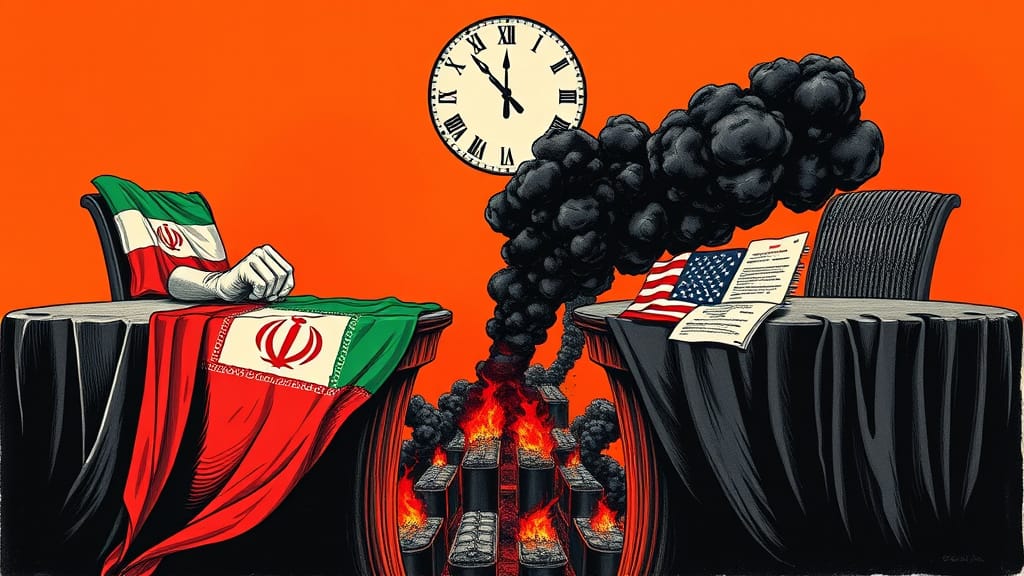
The Ceasefire Trap reveals why modern conflicts resist resolution. Even when peace is rational, power structures make compromise politically impossible. Leaders, institutions, and audiences create pressures that punish de-escalation. In this environment, war continues not from necessity, but because neither side can afford the appearance of stopping.
On the morning of April 6, 2026, Easter Monday, Donald Trump stood on the White House South Lawn and delivered one of the conflict’s most revealing assessments. Egypt, Pakistan, and Turkey had just transmitted a last-ditch 45-day ceasefire proposal to both Tehran and Washington. Iran had rejected it within hours, calling it “illogical.” Trump, when pressed, offered a characteristically paradoxical verdict: the proposal was “not good enough, but it’s a very significant step.” He then walked back inside and let his deadline stand. Tuesday, 8 p.m. Eastern. Open the strait or face strikes on power plants and bridges.
This is not diplomacy failing. It is power making peace impossible.
Five weeks after Operation Epic Fury’s opening strikes killed Supreme Leader Ali Khamenei and shattered Iran’s command hierarchy, neither Washington nor Tehran has been able to agree on even the framework for a temporary pause. Not because peace is strategically irrational, the economics of both nations demand it, but because peace is politically catastrophic for every power broker with a hand on the relevant levers. Both sides have made commitments to domestic audiences, allied networks, and ideological movements that make face-saving compromise nearly impossible without a third force strong enough to absorb the political cost. No such force currently exists.
Contents
Section One: Iran’s Impossible Demands
To understand why Tehran rejected the 45-day proposal so swiftly, Iran’s foreign ministry spokesman Esmail Baghaei told journalists that “negotiations are entirely incompatible with ultimatums, crimes and threats of war crimes” One must first understand who is actually making decisions in Tehran, and what those decision-makers need from any outcome to survive.
The assassination of Ali Khamenei on February 28 did not create a power vacuum. It created something more dangerous: a military-security state in clerical clothing. The new Supreme Leader, Mojtaba Khamenei, has not appeared in public in over five weeks. Real power lies with a triumvirate of IRGC hardliners, commander Ahmad Vahidi, security council secretary Zolghadr, and military adviser Rezaei, all three wanting to continue the war. President Masoud Pezeshkian, who privately believes the economy faces total collapse within weeks, has been systematically overruled.
This is the first layer of Iran’s ceasefire trap: the people with the power to authorise a deal are the same people whose power evaporates the moment a deal is signed. The IRGC’s economic empire, estimated at 30 to 40 per cent of Iran’s GDP, its political supremacy and its revolutionary raison d’être all depend on the narrative of permanent struggle against the United States and Israel. Sanctions that the outside world reads as pressure are, from the IRGC’s perspective, a tariff wall protecting its domestic monopolies. Peace is an institutional threat to the institution that would have to make it.
Beyond institutional interest lies the problem of face. Iran’s response to the U.S., transmitted through Pakistan, includes demands for lifting sanctions and ending other wars in the region. This is not a negotiating floor. It is a survival document. The regime has been executing political prisoners at an accelerating pace, ten executions in eight days, according to human rights groups, using the war as cover to suppress the January protest movement. Any concession that reads as capitulation to the “Great Satan” risks accelerating the internal collapse the hardliners are fighting to prevent.
Iran’s demands have also expanded as the war progressed. What began as a defensive posture around the Strait of Hormuz now encompasses the full architecture of Iran’s regional proxy network. Iranian diplomat Mojtaba Ferdousi Pour stated it plainly: “We only accept an end of the war with guarantees that we won’t be attacked again.” He said Iran no longer trusts the Trump administration after the U.S. bombed the Islamic Republic twice during previous rounds of talks. A comprehensive security guarantee extending across the entire axis of resistance is not something any U.S. administration could plausibly provide.
The rejection of a temporary ceasefire makes this logic explicit. Baghaei explained that a temporary pause would allow the U.S. and Israel to prepare for the continuation of the war. Iran was calling for an end to the war, not a pause before the next round. Araghchi had said Trump “ultimately ordered bombing of the negotiating table” when the war began on February 28, during active indirect talks in Muscat. A side that has watched negotiations used as cover for strikes cannot trust a temporary arrangement. Only a permanent end offers genuine security, and permanent ends require the kind of trust that five weeks of war, and decades of maximum pressure, have completely exhausted.
Section Two: Trump’s Domestic Bind
Trump’s problem is not a single constraint. It is four simultaneous ones, each pulling against the others: his base, his midterm calendar, his stated war aims, and his own deep aversion to appearing weak. Together, they foreclose every realistic exit.
His longtime pollster, Tony Fabrizio, has privately warned that the war is growing increasingly unpopular. Gas prices have surged past $4 per gallon. Stock markets have tumbled to multi-year lows. Thirteen American service members have been confirmed killed. Chief of Staff Susie Wiles and senior aides delivered the message directly: the longer this drags on, the worse November looks.
And yet walking away is politically as dangerous as staying. The MAGA coalition’s fracture over the Iran war strikes at the ideological core of “America First.” Tucker Carlson, Megyn Kelly, Marjorie Taylor Greene, and Matt Walsh have argued that bombing Tehran contradicts everything Trump campaigned on. An adviser to Elon Musk’s 2024 super PAC warned that the war threatens to lose the three voter cohorts that were carefully cultivated to elect Trump. The Al Habtoor Research Centre’s midterm analysis draws a direct parallel to 2006: Republican losses of 31 House seats and 6 Senate seats, driven by public exhaustion with the Iraq War. The Iran war is producing opposition levels inside the Republican base that Iraq didn’t reach until year three, in week seven.
The war aims compound the trap. Trump declared he would accept nothing other than “unconditional surrender,” pledging to restore Iran’s economy only if a new, acceptable leader is installed. He cannot accept a ceasefire without contradicting his own rhetoric. The people who have replaced Iran’s killed senior leaders are known as equally hard-line or more militant than their predecessors. Iran’s new leaders have the same ideology. All are committed to the principles of the 1979 revolution and will rule with greater brutality given their lack of legitimacy.” The regime has not collapsed. The war aims have not been met. A ceasefire now is a concession dressed as a pause.
What Trump actually wants, according to his confidants, is the ability to declare victory and leave “searching for a way to declare victory, halt the fighting, and hope that economic conditions stabilise before the political damage hardens.” But the gap between what was promised and what airstrikes can deliver is so wide that any realistic ceasefire would look, to a significant portion of his base, like another Afghanistan.
Beyond each side’s internal contradictions lie structural barriers that would complicate peace even if both governments were internally unified and free to compromise. These are the mechanics of the trap itself.
The first is the credible commitment problem. Agreements between adversaries hold only as long as enforcement mechanisms exist behind them. A senior Iranian official told Reuters directly that Iran will not reopen the Strait as part of a temporary ceasefire, and that Washington was not ready for a permanent one. Both sides have publicly confirmed they want the thing only the other side can provide first. The U.S. cannot accept Iranian assurances on the nuclear question without verification mechanisms that Tehran would view as sovereignty violations. Iran cannot accept American security guarantees after watching those guarantees expire mid-negotiation on February 28.
| Side | Key Constraint | Political Cost of Compromise | Trust Deficit Driver |
| Iran (IRGC) | Sanctions relief + proxy preservation | Hardliner coup; IRGC loses economic empire | U.S. struck during Muscat talks |
| Iran (Public) | Blackouts, collapse; needs visible victory | Any concession reads as capitulation to “Great Satan” | Decades of unmet promises after 2015 JCPOA |
| U.S. / Trump | MAGA base + midterms + Israel | “Soft on terror”; contradicts own regime-change rhetoric | Iran’s enrichment during prior talks |
| Both | Proxy network fires (Yemen, Syria, Lebanon) | Unilateral commitment cannot bind non-state actors | Houthis, Hezbollah operate semi-autonomously |
The second barrier is the proxy problem. Iran’s demands include ending “other wars in the region”, a condition Tehran cannot satisfy unilaterally even if it wanted to. Hezbollah in Lebanon, the Houthis in Yemen, and armed groups in Iraq released statements backing the new Supreme Leader’s selection, signalling continued autonomous coordination. These are not assets Tehran can switch off with a policy directive. They are semi-autonomous actors with their own organisational interests and domestic political bases. The axis of resistance is simultaneously Iran’s greatest source of regional leverage and its greatest obstacle to any credible commitment to de-escalation.
The third barrier is economic, but not in the way outsiders assume. Iran’s strangled economy creates pressure for peace at the level of ordinary citizens facing blackouts and a collapsing rial. For the IRGC’s financial empire, however, sanctions-driven isolation is not a crisis. It is a business model. Sanctions eliminate foreign competition, create smuggling networks under the IRGC’s control, and justify the security apparatus that protects IRGC interests. Lifting sanctions would be economically catastrophic for this particular constituency. Meanwhile, Iran’s control of the Strait of Hormuz, through which about a fifth of the world’s oil and gas passes, gives Tehran a macroeconomic lever that punishes U.S. allies at least as much as America itself, with Brent crude reaching $109 per barrel. Trump’s energy independence narrative means he cannot yield on Hormuz even as the economic pain spreads globally.
The fourth barrier is the one that seals all the others: both sides have now made maximalist public commitments they cannot walk back without paying a domestic price that exceeds the cost of continued war. Trump threatened strikes on Iranian energy and transport infrastructure if the Strait remained closed. Iranian parliamentary billboards depict American aircraft caught in an IRGC fishing net, declaring the Persian Gulf their hunting ground. These are not negotiating positions. They are identity statements. Retreating from them is not a tactical adjustment; it is a political defeat. Iran’s Foreign Ministry called the 45-day proposal “illogical” and stated that Iran “cannot participate in any negotiations under threat.” A temporary pause looks, to each side’s core constituency, like the pause before the other side rearms.
Conclusion: No Exit Without a Guarantor
The ceasefire trap is a problem of political architecture. Both sides need someone else to absorb the blame for the compromises they must eventually make. What they need is a third party powerful enough to impose terms that can be presented domestically as the result of international pressure rather than a bilateral concession.
Pakistan’s army chief Field Marshal Asim Munir was in contact all night with Vice President Vance, envoy Steve Witkoff, and Iranian Foreign Minister Araghchi, an extraordinary display of diplomatic effort that produced no agreement by morning. Pakistan, Egypt, and Turkey lack the coercive or economic weight to guarantee compliance or absorb the backlash when terms are violated. The most plausible guarantor architectures involve either China, which has leverage over Iranian oil exports and U.S. debt markets and has demonstrated its brokering capacity with the 2023 Saudi-Iran normalisation, or a UN Security Council framework providing both sides with multilateral cover. UAE senior policy adviser Anwar Gargash has said any settlement must guarantee access through Hormuz and must not create “continuous instability in the region”, a formulation that points toward a comprehensive framework rather than a 45-day pause that neither side trusts.
This is the final lesson of the “power replaces strategy” thesis. When belligerents optimise for the display of strength rather than the achievement of defined objectives, they accumulate commitments that make rational exit progressively harder to reach and politically costlier to take. Trump launched Operation Epic Fury with the objectives of nuclear rollback and proxy dismantlement, which were always going to require either sustained occupation or a negotiated settlement. Having framed the war in terms of total victory and regime transformation, he foreclosed the middle. Iran’s IRGC, having built forty years of ideology around permanent resistance, cannot accept partial terms without proving that force works. Each escalation narrows the space for the next.
War continues not because it works, but because neither side can survive the appearance of stopping.
Sources: CNN Live Updates (April 6, 2026); Axios (April 6, 2026); NPR News (April 6, 2026); Reuters / CNBC (April 6, 2026); Time Magazine (April 2, 2026); Al Jazeera Opinion (March 4, 2026); Fortune (March 15, 2026); NBC News (March 14 & April 1, 2026); Atalayar (April 6, 2026); The New Arab (March 2026); Foreign Affairs (March 2026); Council on Foreign Relations (February 24, 2026); Al Habtoor Research Centre (March 2026); Times of Israel (April 6,
Leave a Reply