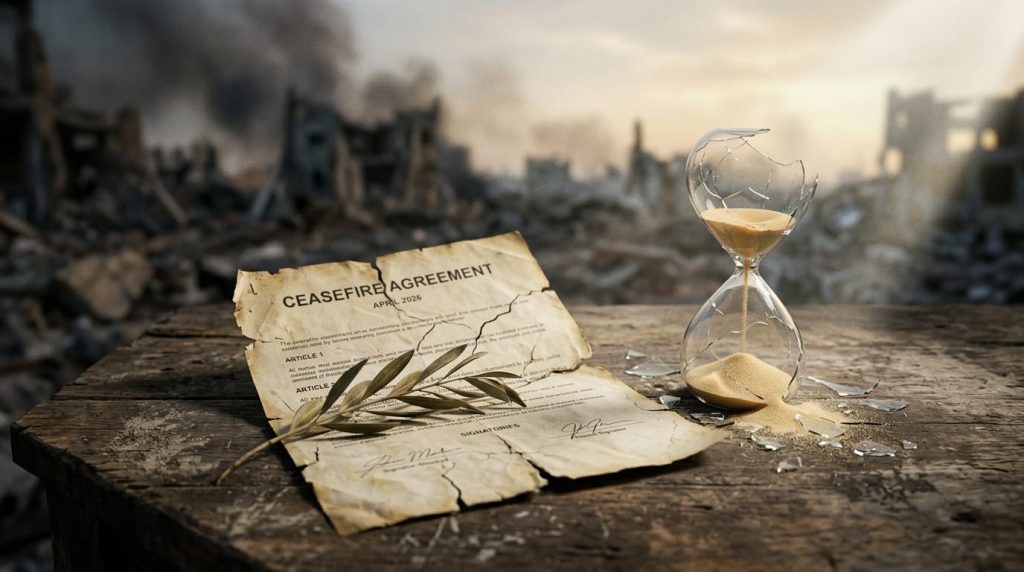
The April 2026 ceasefire analysis reveals a moment of calm built on unstable foundations. While direct conflict between the United States, Iran, and Israel has paused, the deeper structural tensions remain unresolved.
This ceasefire is not a resolution but a temporary alignment of interests, shaped by strategic necessity rather than lasting agreement.
Critically, Lebanon sits outside the framework, creating a dangerous gap where escalation can re-emerge.
Understanding this agreement requires looking beyond diplomacy to the underlying power dynamics it leaves untouched. The April 2026 ceasefire analysis therefore exposes both the limits of short-term peace and the risks embedded within it.
The April 2026 ceasefire between the United States, Iran, and Israel has been widely described as a significant diplomatic achievement, and in narrow terms, it is.
Direct military exchanges between the three principal actors have ceased, backchannel communications have stabilised, and the immediate risk of a broader interstate war has receded. Yet to characterise this moment as a resolution of the underlying conflict would be analytically premature.
The ceasefire stabilises the US–Iran–Israel axis while leaving Lebanon as the most likely point of renewed escalation, a structural weakness that makes either fragile short-term stability or rapid breakdown considerably more probable than any durable settlement.
This blog argues that the agreement is best understood not as a resolution of conflict but as a temporary mechanism for managing escalation, one whose durability depends on whether it can be extended to cover all active fronts, most critically Lebanon.
The Architecture of the Agreement
To evaluate the ceasefire’s significance, it is necessary first to understand what it does and does not do. The agreement establishes a framework for the cessation of direct military hostilities between the United States, Iran, and Israel.
It includes, by most accounts, commitments to halt missile exchanges, suspend drone operations, and maintain open backchannel communication to prevent miscalculation. Structurally, it is a state-to-state instrument designed to manage the behaviour of sovereign governments with identifiable chains of command and calculable interests.
Within those limits, it functions. The incentive structure across all three parties currently favours compliance. For the United States, the ceasefire removes the immediate risk of being drawn into direct military confrontation in an election-adjacent political environment where sustained Middle Eastern entanglement carries high domestic costs.
For Iran, it provides relief from the compounding pressure of sanctions and Israeli strikes on its military and nuclear infrastructure, allowing the regime to consolidate without absorbing further material damage.
For Israel, it neutralises at least temporarily the threat of large-scale Iranian ballistic missile exchanges and creates operational space for internal strategic recalibration.
All three actors, in other words, gain more from a temporary pause than from immediate resumption of hostilities. That convergence of short-term interests is the ceasefire’s genuine strength.
It is also, however, the source of its fundamental fragility. The agreement defers rather than resolves the core disputes that produced the conflict: the question of Iran’s nuclear programme and its regional ambitions, Israel’s security doctrine and its tolerance for Iranian proxy presence on its borders, and the broader contest over the architecture of influence across the Levant and Gulf.
A ceasefire premised on the temporary alignment of interests rather than the resolution of underlying grievances is structurally vulnerable to any shift in those interests and to any development on a front the agreement does not cover.
The Lebanon Problem
The ceasefire’s most consequential weakness is geographic. Lebanon, where Hezbollah retains an extensive military infrastructure and deep organisational ties to Tehran, is not formally incorporated into the agreement’s framework.
This exclusion reflects a genuine negotiating difficulty: Hezbollah is a non-state actor with its own military logic, its own domestic political function within Lebanon’s confessional system, and its own relationship to Iranian strategic direction that is influential but not simply reducible to command.
Folding such an actor into a state-to-state ceasefire architecture is technically and politically complex in ways that folding in a sovereign government is not.
The consequence of that difficulty, however, is a conflict system in which the central axis has been stabilised while one of its most operationally active flanks remains outside the agreement. The stabilising effects of the April ceasefire are therefore geographically bounded.
Their durability depends on whether the framework can be extended beyond the three principal states, and that extension, if it is to mean anything, must include Lebanon.
A ceasefire that holds between Washington, Tehran, and Jerusalem but leaves Hezbollah’s military capacity intact, its political incentives unchanged, and its operational freedom unaddressed is not a ceasefire in any structurally meaningful sense. It is a pause with an open flank.
This is not merely a theoretical concern. The historical record of partial ceasefires in multi-front conflicts consistently shows that excluded theatres are the most likely sites of breakdown.
The 2006 UN-brokered ceasefire in Lebanon, formalised through Security Council Resolution 1701, offers the clearest regional precedent. The agreement succeeded in ending direct Israeli–Hezbollah hostilities but failed to dismantle Hezbollah’s military infrastructure or resolve the rearmament question.
The result was not a stable peace but a frozen conflict, one that preserved the form of a ceasefire while leaving the conditions for renewed escalation structurally intact.
The pattern is broader than this single case: excluded fronts in partial agreements displace pressure rather than resolve it, and that displaced pressure tends to re-emerge along the path of least resistance. Lebanon, in the current configuration, is precisely that path.
Scenario Analysis
Three trajectories follow from this structural situation, and they are not equally probable.
The most likely near-term outcome is fragile stability. The convergence of interests described above is real, and the immediate costs of resumed escalation remain high for all principal actors. Iran is not currently in a position to absorb further Israeli strikes without significant material consequences.
Israel has achieved a degree of strategic relief and has a limited appetite for a multi-front ground campaign. The United States has strong incentives to maintain the ceasefire as a foreign policy achievement.
These pressures sustain compliance in the short run. But fragile stability is fragile precisely because it rests on a contingent alignment of interests rather than a resolution of the underlying conflict. It is the most probable outcome not because the peace is durable, but because the costs of immediate breakdown remain, for now, prohibitive.
The second scenario is renewed escalation, most plausibly triggered not by deliberate policy decision from any of the three principal actors but through a Lebanese flashpoint that the existing framework is not equipped to contain.
Hezbollah retains both the operational capability and, depending on the evolution of Iranian strategic guidance and internal Lebanese political dynamics, a plausible motivation to conduct operations that test the ceasefire’s boundaries.
An Israeli strike on Hezbollah infrastructure in response to a provocation, a significant rocket exchange across the northern Israeli border, or a miscalculation in an already compressed operational environment could each generate escalatory pressure that cascades beyond the Lebanon front.
Excluded theatres are historically the most common point of breakdown in partial agreements for precisely this reason: they fall outside the formal communication and restraint mechanisms established by the ceasefire between the principal states, and therefore lack the institutional buffers that might otherwise absorb a crisis before it escalates.
This scenario is less immediately probable than fragile stability but becomes progressively more likely the longer the Lebanon question remains structurally unaddressed.
The third scenario, a comprehensive diplomatic settlement resolving the underlying disputes over Iran’s nuclear programme, Israeli security guarantees, and regional proxy architecture, remains the least probable outcome in any meaningful near-to-medium term horizon.
The core disagreements are not bridgeable with the instruments currently available, and the ceasefire does not, in itself, create the political conditions necessary for the sustained, high-stakes, comprehensive negotiation that a genuine settlement would require.
What it may create, at best, is a window of reduced immediate pressure during which such negotiations could, in principle, begin. Whether that window is used, and by whom, is a political question that the structural analysis cannot answer.
Conclusion
The April 2026 ceasefire is a meaningful diplomatic development, and its achievement should not be dismissed. The reduction in immediate escalation risk between three actors capable of triggering a regional war is a substantive outcome. But the significance of the agreement must be assessed with analytical precision rather than diplomatic optimism.
Its stabilising effects are real, and its incentive structure is currently functional, but both are geographically bounded and temporally contingent.
The exclusion of Lebanon creates a structural weakness that no degree of compliance between the principal states can fully compensate for, and the historical pattern of partial ceasefires in multi-front conflicts offers little comfort on this point.
As such, the April 2026 ceasefire is best understood not as a resolution of the underlying conflict but as a temporary mechanism for managing escalation, one whose success depends ultimately on whether it can be expanded to include all active fronts.
Whether the diplomatic space it opens is used to address the Lebanon question, and whether the broader structural disputes that produced the conflict are eventually brought within a negotiated framework, will determine whether this moment is remembered as the beginning of a genuine de-escalatory process or as another partial agreement that deferred breakdown rather than preventing it.
The ceasefire has bought time. What is done with that time remains, for now, an open question.
Leave a Reply