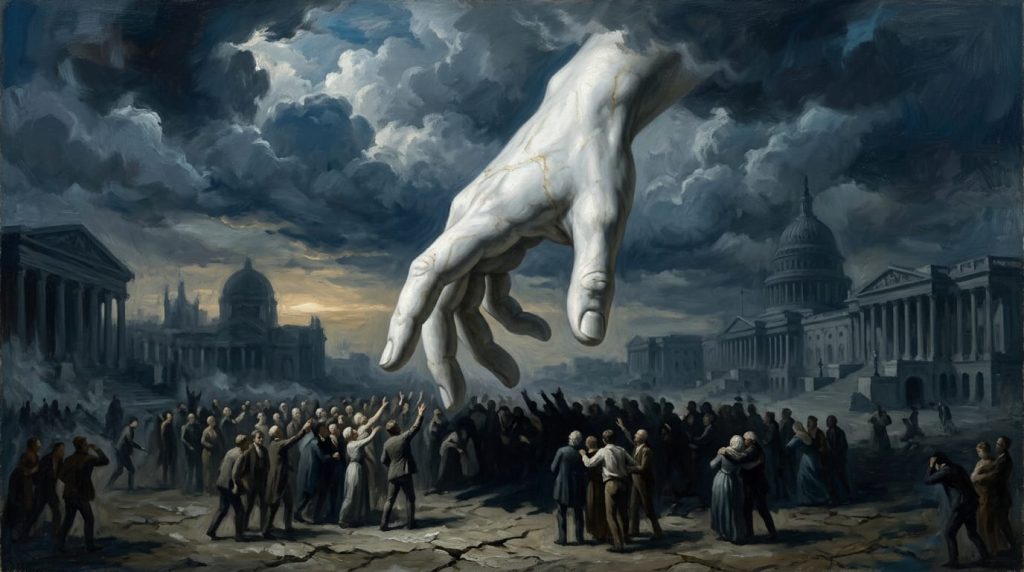
The concept of a social contract breakdown helps explain why trust in institutions is eroding across society.
When systems fail to provide opportunity, security, and fairness, individuals begin to disengage from the rules that once held communities together.
Rising unemployment, economic pressure, and weak enforcement all contribute to a growing sense that the system no longer works for everyone. This breakdown is not sudden; it builds over time as people feel excluded or overlooked.
Understanding social contract breakdown is essential to addressing not just visible issues like crime, but the deeper structural conditions that allow them to persist and spread.
Humanitarian Intervention as an Instrument of Power
Humanitarian intervention is commonly understood as the use or threat of military force by external actors to prevent or halt large-scale human rights abuses within a sovereign state without that state’s consent.
This blog argues that, rather than being a neutral moral imperative, humanitarian intervention historically and in contemporary practice functions as a flexible political instrument.
Powerful states, especially Western liberal powers, use this tool to legitimise coercive force, advance geostrategic and economic interests, and reshape international norms, reproducing hierarchical power relations under the rhetoric of universal human rights.
The concept centres on a core tension: a supposed moral duty to protect strangers against a history of selective, interest-driven application.
Liberal internationalists, including Fernando Tesón and Nicholas Wheeler, see humanitarian intervention as a sign of ethical progress and a developing international norm. They believe it shows the world is moving toward institutions that act on shared moral principles.
On the other hand, scholars like Noam Chomsky, David Chandler, and Anne Orford argue that humanitarian intervention is a form of modern imperialism. They suggest that the focus on rights can be used to justify the use of power and maintain global inequalities.
This blog builds on the premise established above: humanitarian intervention has never been a neutral moral imperative. Instead, it has functioned, historically and in contemporary practice, as a flexible political instrument.
Through it, powerful states, especially Western liberal powers, legitimise the use of coercive force, advance geostrategic and economic interests, and reshape international norms, all while reproducing hierarchical power relations under the rhetoric of universal human rights.
This blog argues that humanitarian intervention is not a neutral moral imperative. Instead, it is a political tool used by powerful countries, especially those in the West, to legitimise military action, pursue economic and strategic goals, and influence global norms, while still maintaining power imbalances under the language of human rights.
Before the argument can proceed, several distinctions require clarification. Classical imperialism involved direct territorial control and economic extraction.
Liberal interventionism, by contrast, uses a temporary “trusteeship”: the intervening power enters, stabilises, reconstructs, and, in principle, withdraws under human rights norms. The surface difference is real; the underlying power dynamic remains unchanged.
Westphalian sovereignty is the principle of non-interference in states’ internal affairs. Since the 1990s, it has faced a challenge from a new “responsibility” norm. This trend culminated in the codification of the Responsibility to Protect at the 2005 World Summit.
This shift in vocabulary from ‘intervention as a right’ to ‘protection as a duty’ deserves scrutiny. It hides, rather than resolves, the power relations it changes.
Three traditions in International Relations theory shape the debate. Realism, as Hans Morgenthau and John Mearsheimer argue, holds that states intervene only when power and interest align. Humanitarian justifications are secondary, a gloss on real, strategic choices.
Liberal cosmopolitanism, grounded in Kant and updated by R2P, holds that moral progress is real. International institutions can gradually embed universal norms despite power politics. Critical, postcolonial, and Marxist theories reject both. They see intervention as domination that shapes new kinds of hierarchy.
Foucault’s analysis views human rights discourse as a tool of governmentality, a means of producing, managing, and disciplining populations. Said’s account of Orientalist framing shows how the “barbaric” Other becomes an object for civilizational rescue.
Carl Schmitt’s idea of the ‘exception’ helps show that those who decide when rules can be set aside in a crisis have real authority. The act of making that decision reveals who holds genuine power.
Applied to humanitarian intervention, this means that whoever decides which crises warrant force and which do not exercises sovereignty. This power goes beyond formal equality between states.
The mechanism connecting these theories is what this blog calls “moral language as strategic cover.”
This is a discursive process with a typical sequence. A crisis is named and given moral weight. The intervening state is cast as the guardian of victims.
Legal limits, such as Article 2(4) of the UN Charter, are suspended as an exception. Strategic interests are turned into apparent universal imperatives.
Moral language does not drive intervention; it recasts strategic decisions as ethical necessities. This is the blog’s central claim, supported by historical and contemporary evidence.
Contemporary humanitarian intervention is not new. Its model appeared in the nineteenth century. Tracing that legacy is crucial to the argument.
In the Ottoman Empire, the Greek War of Independence (1821–1830), and the response to the Bulgarian atrocities of 1876, interventions were publicly framed as protecting Christians. At the same time, they advanced the management of the Eastern Question and contained Ottoman decline in ways that suited European interests.
Britain and France were not operating from simple philanthropic impulses; they were managing a complex of imperial rivalries under a moral idiom that made intervention legible and legitimate to domestic publics. The humanitarian framing was not incidental to the strategic calculation; it was what made the calculation executable.
British abolitionist rhetoric offers a more complex example. The fight against the slave trade began as a real moral movement. Convictions ran deep and were politically costly.
Naval patrols enforcing abolition in West Africa and the Indian Ocean also boosted British commerce. They gave Britain a strategic foothold along coasts, soon to be seized in imperial rivalries.
Moral purpose and material interests were mutually reinforcing. The abolition campaign gave Britain uncontested moral standing, which was later used to expand authority over trade relationships.
The ‘civilising mission,’ or mission civilisatrice, made the logic clear. It explained what abolitionist rhetoric had partly hidden.
French Algeria, British India and Africa, and the Belgian Congo were ruled under narratives of moral and civilizational superiority, justifying conquest and resource extraction. The governed were depicted as barbaric and in need of outside rule, serving the material interests of the coloniser.
The Belgian Congo deserves special attention. It saw one of the first international humanitarian campaigns. Led by E.D. Morel and the Congo Reform Association, it challenged Leopold II’s atrocities and eventually led to the transfer of control to the Belgian state.
This doesn’t break the thesis; it clarifies it. Genuine humanitarian action was quickly absorbed by competing imperial interests. The campaign against Leopold didn’t end with extraction; it changed its form.
The nineteenth century set the template: moral rhetoric fused with great-power interest to produce hierarchy. That template remains.
The Cold War didn’t stop humanitarian language in international politics. Instead, it split it in two.
Both superpowers claimed to represent universal interests: one for liberal democracy, one for socialist internationalism. Each used moral language to justify interventions that were really strategic.
The US said Vietnam (1965-1973) was about defending freedom and stopping communism. The Soviet Union called its 1979 intervention in Afghanistan “fraternal assistance” to a socialist ally.
In both cases, the humanitarian justification did not withstand scrutiny. Yet, the moral language had an essential role in securing domestic and international support.
Each superpower built its own vocabulary of universal obligation and used it selectively to serve particular ideological and strategic aims.
Bipolarity meant that a real universal humanitarian norm could not exist institutionally.
Each bloc invoked morality exclusively in cases where moral framing aligned with ideological interest. Crises within client states were ignored, managed, or actively exacerbated by the United States supporting authoritarian regimes across Latin America and Southeast Asia, the Soviet Union doing the same across Eastern Europe and Central Asia, and the language of human rights was reserved for atrocities committed by the opposing bloc.
The Cold War did not suppress humanitarian discourse; it revealed, with unusual clarity, that humanitarian discourse is always embedded in structures of power that determine its activation.
The important analytical point for this blog is that the post-Cold War “unipolar moment” did not create humanitarian discourse; it monopolised it.
When the Soviet Union collapsed, one of the two competing universalisms disappeared, leaving Western liberal humanitarianism as the only available idiom of legitimate international action.
This monopoly was not the result of Western values being objectively superior; it was the result of one side winning a geopolitical contest.
The institutionalisation of the humanitarian intervention norm in the 1990s must be understood against this background, because the norm that was institutionalised was not a neutral, universal one; it was a specifically Western, liberal one, embedded in Western institutional structures and enforced by Western military capacity.
The 1990s saw explicit doctrinal development. Somalia in 1992, Bosnia in 1995, and Kosovo in 1999 constituted a sequence of interventions that, taken together, established new precedents and new expectations about when force could and should be deployed in the name of human protection.
Each case was presented as evidence of an emerging international conscience; each case was also shaped by strategic calculations that the humanitarian framing partly obscured.
The Responsibility to Protect, codified at the 2005 World Summit, was the institutional crystallisation of this process, a deliberate reframing of humanitarian intervention as a responsibility borne by the international community, triggered when sovereign states fail to protect their own populations. The language of R2P is morally serious. Its operation is politically structured.
NATO’s Kosovo campaign, conducted without a UN Security Council mandate, established the precedent of action described by the Independent International Commission on Kosovo as “illegal but legitimate”, a formulation that, whatever its philosophical ambitions, effectively granted a self-selected coalition of Western powers the authority to determine when legal constraints could be overridden by moral ones.
The monopoly on defining which crises constitute emergencies and which actors constitute legitimate responders was thereby institutionalised within Global North structures. R2P did not resolve this problem; it gave it a new vocabulary and a formal normative framework that lent the monopoly an appearance of universality it had not previously possessed.
Three cases illuminate the gap between stated humanitarian aims and actual strategic outcomes with particular clarity, and each demonstrates a distinct mechanism of the general thesis.
Kosovo in 1999 is the paradigmatic case of legal rupture. The intervention was conducted without a UN Security Council mandate and justified primarily on the grounds of preventing ethnic cleansing and potential genocide.
The humanitarian framing was not simply pretextual; genuine atrocities were occurring, and the memory of Srebrenica four years earlier was politically and morally vivid, but it operated alongside and in service of NATO’s strategic need to reassert credibility following its paralysis over Bosnia, and to consolidate a post-Cold War European security order in which the Alliance remained the primary guarantor of stability.
The means chosen, sustained aerial bombardment conducted over seventy-eight days, itself caused significant civilian casualties and generated refugee flows that had partly justified the action in the first place.
What Kosovo established above all was that powerful Western coalitions could determine unilaterally when the legal order could be suspended, Schmitt’s exception operationalised at the international level. The moral language did not cause the intervention.
It converted a strategic calculation about NATO’s future into an ethical imperative about Kosovo’s present, and in doing so set a precedent that subsequent interventions would inherit and extend.
Iraq in 2003 sharpens the argument further, and in a direction that the Kosovo case does not fully expose. The primary public justifications for the invasion, weapons of mass destruction and alleged operational connections between Saddam Hussein’s government and al-Qaeda, collapsed under scrutiny before and certainly after the invasion.
What is analytically significant is not merely that these justifications were false, but what happened after their falsity became undeniable. The secondary “humanitarian liberation” narrative, which had been present from the beginning as a supporting argument, was not abandoned when the primary case disintegrated; it was amplified.
The argument shifted from “we must invade to prevent catastrophe” to “we have liberated the Iraqi people from a monstrous regime,” and this shift was presented not as a change of justification but as a revelation of the intervention’s deeper moral meaning. Iraq thus demonstrates a mechanism that Kosovo does not: humanitarian rhetoric functioning not only as cover before action, but as repair after failure.
Morality in this reading is not just the justification for intervention; it is the resource available for retrospective legitimation when the original justification is destroyed. This is the most cynical deployment of moral language documented in this blog because it converts the suffering produced by the intervention itself into evidence of the intervention’s humanitarian necessity.
The outcomes foreclose any honest use of that narrative: hundreds of thousands of Iraqi civilians dead by conservative estimates, the institutional dismantling of the Iraqi state creating the conditions for the rise of the Islamic State, and the strategic empowerment of Iran across the region, all of this directly and catastrophically contradict the liberation claims. Iraq is the clearest demonstration that moral language serves a strategic function both before and after the fact.
Libya in 2011 demonstrates the mechanism of mandate creep with particular precision, and its consequence chain deserves to be followed to its structural conclusion rather than listed as a series of unfortunate outcomes.
UN Security Council Resolution 1973 authorised member states to take all necessary measures to protect civilians, a mandate rooted explicitly in R2P and presented as its first full operationalisation, the moment at which the norm moved from rhetorical commitment to operational reality.
The NATO campaign that followed rapidly translated civilian protection into sustained air support for the rebel forces seeking to overthrow Muammar Gaddafi. That translation from protection to regime change was not a failure of implementation; it was a choice, made by intervening powers who determined that civilian protection and regime survival were incompatible objectives.
Regime change produced institutional collapse: the Libyan state, already fragile, disintegrated into competing militias and rival governments that persist to this day. Institutional collapse generated a security vacuum across Libya and the broader Sahel, through which weapons, fighters, and organised criminal networks spread across Mali, Niger, Chad, and beyond, destabilising governments and enabling insurgencies that have cost tens of thousands of lives.
The security vacuum drove mass migration northward across the Mediterranean, producing a migration crisis that became one of the defining political forces reshaping European domestic politics across the subsequent decade.
Each link in that chain follows causally from the preceding one. Civilian protection produced regime change; regime change produced institutional collapse; institutional collapse produced regional destabilisation; regional destabilisation produced migration pressure that reorganised European politics in ways the intervening powers neither planned for nor accepted responsibility for.
Libya thus demonstrates not only that R2P can be used as legal cover for exceeding a mandate, but that the regime change it licenses produces, structurally and predictably, the very humanitarian catastrophes it claims to prevent.
Uneven application of the humanitarian intervention norm is not an anomaly that embarrasses an otherwise sound principle. It is structural evidence that the norm functions as a discretionary tool of power, activated when strategic conditions align and dormant when they do not.
The contrast between Rwanda and Kosovo is the most instructive empirical moment this history offers, and it deserves extended treatment.
In Rwanda in 1994, between 500,000 and 800,000 people were killed in approximately one hundred days, a rate of killing that exceeded even the industrial genocide of the Second World War in its concentration of time.
The international community did not intervene. General Roméo Dallaire, the UN Force Commander in Rwanda, transmitted detailed intelligence warnings to UN headquarters in January 1994, months before the genocide began, describing weapons caches, militia training, and explicit plans for mass killing. The UN’s response was to prohibit him from acting on that intelligence.
The Carlsson Commission, established after the genocide to review the UN’s conduct, confirmed that the Security Council had received warnings and chosen inaction not from ignorance, but from a calculated assessment that Rwanda did not warrant the political and military costs of intervention.
The United States, still absorbing the domestic political consequences of the Mogadishu disaster eighteen months earlier, actively resisted using the word “genocide” in official communications because using it would have triggered legal obligations under the 1948 Genocide Convention. Rwanda was a decision, not an oversight.
In Kosovo, five years later, with casualty figures that, at the point of intervention, were significantly lower than those in Rwanda, NATO moved within months. The difference was not moral urgency; if moral urgency had been the operative variable, Rwanda would have produced a faster, more robust response.
The difference was strategic stakes. Rwanda offered nothing: no significant natural resources, no geostrategic position, no alliance relationships that made stability in Kigali important to Washington, London, or Brussels. Kosovo, by contrast, sat at the centre of European stability calculations, threatened to destabilise neighbouring NATO members, and offered NATO an opportunity to demonstrate post-Cold War relevance at a moment when the Alliance’s purpose was under genuine internal debate.
The moral language activated in Kosovo stemmed from a strategic decision. It did not activate in Rwanda because no such decision had been made. This is the mechanism the thesis identifies: moral language converts strategic decisions into ethical necessities, and in the absence of a strategic decision, no ethical necessity is recognised.
Contemporary contrasts extend and confirm the pattern with specificity. In Libya in 2011, R2P was invoked within weeks of the crisis escalating, Security Council authorisation was obtained, and NATO intervention followed promptly.
In Syria, where chemical weapons were used against civilian populations on multiple documented occasions, including the Ghouta attack of August 2013, which killed over a thousand people, the international response was limited, inconsistent, and ultimately ineffective.
The difference was not moral: the Syrian government’s use of chemical weapons against its own civilian population represents one of the clearest violations of international humanitarian law of the past decade. The difference was strategic cost and institutional architecture.
Russia and China, both with interests in Syrian stability, exercised their Security Council vetoes to block authorisation for intervention. The Syrian government possessed sophisticated air defences, Russian military support, and Hezbollah allies that made intervention militarily costly in ways that Libya’s relatively limited military capacity did not. The strategic calculation did not align, and R2P therefore did not activate.
Yemen presents the most structurally revealing case of all, because it demonstrates not merely the absence of intervention but its inverse.
Since 2015, a Saudi-led coalition has conducted a military campaign in Yemen that has produced one of the world’s worst humanitarian crises: documented strikes on hospitals, schools, weddings, and funeral gatherings; a famine affecting millions; and a cholera epidemic of historic scale.
R2P has not been invoked. More than that, the United States, the United Kingdom, and France have continued to sell arms to Saudi Arabia throughout the conflict, arms that have been used in the strikes that produced the documented atrocities.
Western governments have not merely declined to invoke humanitarian norms; they have actively provided material support to the forces committing the violations. In Yemen, the moral language is not simply absent; it is structurally inaudible, because the perpetrators are allied states whose strategic relationships Western governments are unwilling to compromise.
The norm does not apply when its application would be costly for those who control it. That is not an imperfection in R2P. It is R2P’s operational logic.
The selectivity analysis leads directly to a structural critique that goes beyond individual decisions and individual crises. Western dominance in what scholars call “norm entrepreneurship”, the capacity to define, promote, and institutionalise international norms, is not incidental to the humanitarian intervention regime; it is constitutive of it.
The UN Security Council, where veto power concentrates decision-making authority in five permanent members, three of which are Western liberal democracies closely aligned in strategic culture and alliance relationships, is the institutional architecture through which humanitarian intervention is authorised or blocked.
NATO, the military alliance of Western liberal democracies, is the de facto enforcement arm of the norm, meaning that R2P’s operational reach is precisely coextensive with the military capacity and political will of the Atlantic Alliance.
The norm is not global in its institutional foundations; it is Western, and its apparent universality is an artefact of Western dominance in global institutional design.
Anne Orford’s concept of “international executive rule” captures the deeper dynamic. Repeated intervention, even when temporary in its formal structure, produces a form of ongoing administrative authority over intervened-upon states.
The intervening powers determine transition arrangements, institutional designs, political processes, and economic frameworks in ways that outlast the formal intervention and embed the intervening power’s preferences in the post-intervention order.
This positions the Global North as the permanent guardian of a Global South characterised, in the discourse legitimising intervention, as perpetually requiring external management to achieve the standards of governance and rights protection that the Global North has already, in its own self-assessment, attained.
This is not classical imperialism; there are no colonial governors, no formal territorial annexation, no explicit extraction regimes. But it reproduces the fundamental hierarchy of imperial relationships in a liberal idiom, and does so through mechanisms of normative authority, institutional design, and military capacity that are more durable and less visible than those of classical colonialism.
Foucault’s framework of governmentality illuminates the discursive dimension of this process: the construction of populations as objects of protection, management, and improvement is itself a form of power, one that operates through the production of knowledge about what is normal, what is pathological, and who is qualified to make that distinction.
Said’s analysis of Orientalism identifies the cultural content of that construction: the “barbaric” Other who requires rescue is a product of a specific historical imagination that served and continues to serve imperial purposes.
Chomsky and Chandler’s characterisation of liberal interventionism as a “new imperialism” that masks material interests behind the language of universal values completes the diagnosis: the mechanism is not simply cynical, it operates through genuine belief as well as calculated manipulation, but its structural effects are imperial regardless of the sincerity of the beliefs that sustain it.
The argument advanced in this blog must confront its strongest objections directly, without minimising their force.
Genuine successes exist. The UK intervention in Sierra Leone in 2000 halted the Revolutionary United Front’s campaign of atrocities, a campaign characterised by systematic mutilation, sexual violence, and the use of child soldiers, effectively and at relatively low cost, and the intervening power withdrew without installing a client regime or restructuring the political economy in ways that primarily served British interests.
NATO action in Bosnia in 1995, culminating in the Dayton Agreement, stopped the immediate killing following Srebrenica and produced a ceasefire that, however imperfect and however contested the political settlement, prevented further massacres.
The counter-claim that non-intervention can be morally worse than intervention carries genuine weight: Rwanda in 1994 is the standing refutation of any position that treats non-interference as a morally safe default.
Defenders of R2P argue, with some force, that the norm is evolving and imperfect rather than inherently imperial, and that the appropriate response to inconsistent application is institutional reform, stronger authorisation mechanisms, clearer criteria, greater accountability for outcomes rather than normative abandonment.
These objections must be taken seriously before they are answered, because they point to real phenomena that any honest account of the subject must incorporate. Sierra Leone and Bosnia are not fabrications; the people whose lives were saved by those interventions were real, and their survival matters.
The concession, however, clarifies rather than undermines the structural argument. Sierra Leone and Bosnia succeeded to the extent that they did because they were cheap, clear, and strategically convenient.
Sierra Leone was militarily manageable: the RUF was a non-state armed group without sophisticated military capacity, air defences, or powerful external patrons. It was politically legible: the perpetrator was unambiguous and the victim population clearly identifiable.
It was domestically supportable in the UK: the intervention did not risk significant British casualties, did not require extended commitment, and did not engage alliance relationships that might have complicated it. Bosnia was strategically important to NATO and the EU in ways that made stabilisation a shared interest among the intervening powers, not merely a moral choice.
The lesson Sierra Leone and Bosnia teach is not that R2P works when properly applied. The lesson is that intervention succeeds when conditions that R2P cannot produce align: a manageable military environment, clear political stakes, affordable costs, and a strategic interest that makes the intervening powers willing to accept the risks.
The norm provides no mechanism for ensuring those conditions exist, no mechanism for generating the political will to intervene when they do not, and no mechanism for preventing intervention when they are present but the moral case is weaker or absent.
Its reliance on great-power consensus and military capacity ensures, precisely as Schmitt’s analysis predicts, that the exception will always be decided by the powerful on terms favourable to the powerful. The existence of genuine successes does not negate the systemic pattern; it confirms it. Intervention occurs when it is strategically convenient, and the moral language follows.
Humanitarian intervention operates within power politics, not above it. Moral language performs a strategic function: it converts particular interests into universal imperatives, enables powerful states to bypass legal constraints while appearing ethically superior, and legitimises the reproduction of global hierarchy in the idiom of universal rights.
This function has been documented across two centuries and across every phase of international order examined in this blog. The nineteenth-century civilising mission established the template moral rhetoric, combined with great-power interest, producing hierarchical outcomes.
The Cold War demonstrated that the template was not specific to liberal powers but was available to any hegemonic actor with a universalist ideological claim.
The post-Cold War period institutionalised the Western template in the architecture of international law and international organisations, giving it a formal, normative framework that obscured its particularity behind the appearance of universality.
Iraq demonstrated that the function of moral language extends beyond pre-intervention justification into post-failure repair: when the strategic case collapsed, the humanitarian narrative was amplified rather than abandoned, converting the suffering produced by the intervention into retrospective evidence of its necessity.
Libya demonstrated that the humanitarian mandate, once invoked, becomes a mechanism for exceeding itself. Civilian protection becomes regime change, becomes institutional collapse, becomes regional destabilisation, becomes migration crisis, and this cascade is not contingent but structural, a predictable consequence of intervening in complex political environments with short-term military instruments and no sustained commitment to the post-intervention order.
The selectivity record Rwanda ignored while Kosovo acted upon, Yemen enabled while Libya targeted, confirmed that the norm does not activate when moral urgency is highest, but when strategic conditions align.
This dual character of humanitarian intervention must be held in view without resolving the tension it creates. The moral vocabulary is both indispensable, as it is the only available idiom for articulating obligations to strangers across state borders, and without it, the case for any international response to atrocity is weakened and consistently instrumentalised in ways that serve the interests of the powerful and reproduce the hierarchies it claims to challenge. The vocabulary cannot be abandoned without cost, and it cannot be trusted without scrutiny. That is the uncomfortable position the evidence demands.
In a multipolar era, this tension is sharpening rather than resolving. Rising powers, including China and Russia, and coalitions within the Global South increasingly contest liberal interventionism not primarily because they are indifferent to human rights, but because they recognise the norm as a mechanism of Western authority and a threat to their own sovereignty.
That recognition, whatever its own political motivations and whatever the human rights records of the states expressing it, is analytically accurate. The norm has functioned as a mechanism of Western authority. Contesting it on those grounds is not simply bad-faith obstructionism; it is a response to a real structural feature of the norm’s operation.
Reforms are possible and worth pursuing. Stronger multilateral authorisation thresholds that require broader consensus before force is authorised could raise the political cost of unilateral action dressed up as collective responsibility.
Independent monitoring mechanisms that track compliance with intervention mandates could reduce the scope for the kind of mandate creep exemplified by Libya. Clearer legal constraints on the relationship between civilian protection and regime change could limit the distance between what is authorised and what is executed.
Meaningful accountability frameworks that impose genuine political and legal costs on intervening powers for post-intervention outcomes could create incentives for longer-term commitment and against the short-termism that has characterised most interventions examined here.
None of these reforms will eliminate the power asymmetries that are the root cause of the pattern documented in this blog. What they can do is raise the political cost of hypocrisy and, in a domain where moral language is the primary instrument of legitimation, where the capacity to appear ethical is itself a form of power, raising that cost is not a trivial achievement.
Until the architecture of global power is genuinely democratised, however, humanitarian intervention will remain what it has historically been: an instrument of the strong, dressed in the language of the universal. What appears as moral obligation is, in practice, discretionary power, and the distance between those two things is where the politics lives.
Leave a Reply