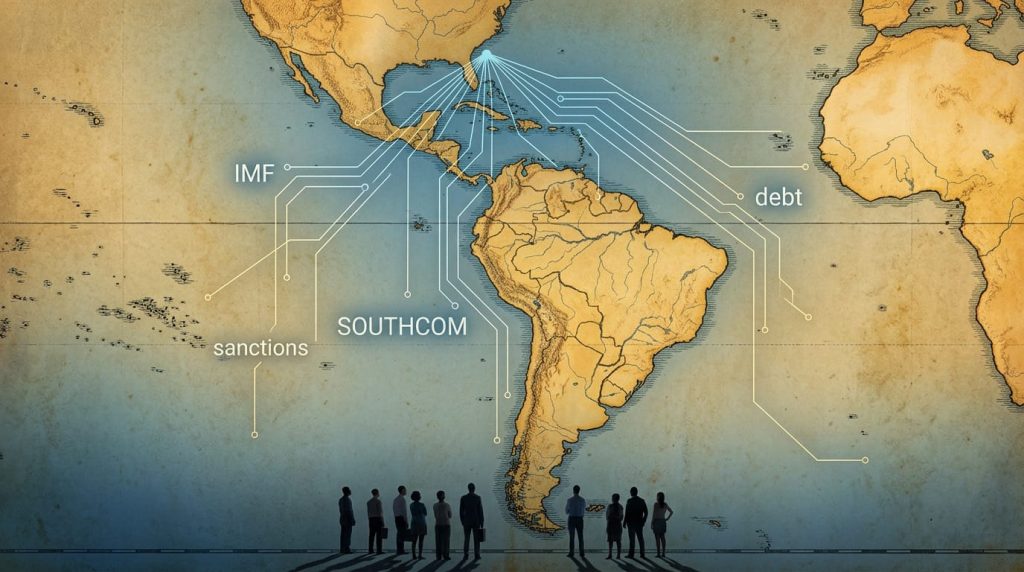
The Monroe Doctrine 2026 is often treated as a relic of nineteenth-century diplomacy, yet its logic continues to shape power in the Western Hemisphere.
No longer enforced through overt intervention, it operates through financial systems, sanctions, and institutional influence that constrain the choices of Latin American states.
This shift from direct control to indirect pressure has not ended imperial dynamics; it has refined them. By examining how economic leverage, political recognition, and global institutions function today, the Monroe Doctrine 2026 reveals a system in which authority persists without visible rule, and in which the costs of that system are unevenly distributed across populations rather than power centres.
Contents
- 1 Introduction
- 2 Historical Background: Establishing the Pattern
- 3 Conceptual Framework: Defining Imperialism by Other Means
- 4 The Doctrine in 2026: The Architecture Is Still Running
- 5 Case Studies: Mechanism and Consequence
- 6 The Architecture of Informal Empire
- 7 Counterarguments
- 8 Critical Evaluation: The Uncomfortable Conclusion
- 9 Conclusion
Introduction
The Monroe Doctrine is generally taught as a historical event. It appears in textbooks as a nineteenth-century declaration. James Monroe addressed Congress in 1823, warning European powers to stay out of the Western Hemisphere. This is often framed as defensive, even noble: a young republic drawing a line around its neighbourhood.
Textbooks rarely explain that the doctrine never ended—it evolved. By 2026, it operates with far greater sophistication, reach, and insulation from accountability than anything Monroe’s administration could have designed.
This blog argues that the Monroe Doctrine’s legacy in 2026 is imperialism by other means. This is not the imperialism of gunboats and governors, or of territorial annexation and explicit colonial administration. That form of empire became too visible, too resistible, and too costly in reputation to sustain.
What replaced it is a system defined by economic coercion, financial architecture, political interference, and selective multilateralism. This system replicates the structural effects of formal empire but operates largely invisibly to affected populations and is rarely held accountable by international governing institutions.
This argument does not focus primarily on intentions. U.S. policymakers may genuinely believe they promote stability, democracy, and development in Latin America—beliefs historically shared by imperial administrators. Such beliefs, however, do not alter the material outcomes.
What matters is the relationship: who holds power, whose choices are limited by others’ preferences, who absorbs the costs, and who is insulated from consequences. By these measures, the Monroe Doctrine’s second life is clear.
Historical Background: Establishing the Pattern
The Monroe Doctrine emerged from a specific context. In 1823, most of Latin America had just gained independence from Spain and Portugal. European powers, particularly France and Russia, were suspected of ambitions to reassert colonial influence. Monroe’s declaration was, in context, genuinely anti-colonial: Europe should stay out of the Western Hemisphere.
The doctrine did not merely defend Latin American sovereignty. It marked the hemisphere as a U.S. zone of authority. Europe was excluded not because Latin America held a right to self-determination, but because the United States asserted the prerogative to define the region’s political order. This distinction is crucial. From the outset, the Monroe Doctrine advanced U.S. access and primacy while cloaking itself in protective rhetoric.
The Roosevelt Corollary of 1904 made this explicit. Theodore Roosevelt declared that the United States had the right, indeed the obligation, to intervene in Latin American nations that proved unable to maintain order or meet their international financial obligations.
Defence of the hemisphere from Europe evolved into the asserted right to act as the hemisphere’s police force. The language of protection merged with the language of domination—two ideas that were always closer than the original doctrine acknowledged.
Across the twentieth century, a consistent pattern emerged. In Guatemala in 1954, a democratically elected government pursuing land reform was overthrown in a CIA-backed coup for threatening United Fruit Company’s interests and U.S. Cold War priorities.
In Chile in 1973, Salvador Allende’s elected socialist government was destabilised through economic pressure and covert action, culminating in Pinochet’s coup. Operation Condor, a coordinated U.S.-backed campaign of political repression across Argentina, Chile, Uruguay, Paraguay, Bolivia, and Brazil, resulted in the torture and disappearance of tens of thousands of people.
In Nicaragua, the U.S. funded the Contra insurgency against the Sandinista government throughout the 1980s, mined Nicaraguan harbours, and was condemned by the International Court of Justice for violating international law.
The pattern in all these cases is the same. When Latin American governments pursued policies that threatened U.S. strategic or economic interests, the doctrine of hemispheric protection was used, explicitly or implicitly, to justify intervention.
Democracy was supported when it produced compliant governments and undermined when it did not. The doctrine was never about protecting Latin America. It was about protecting U.S. access to Latin America. That is the throughline that runs unbroken from 1823 to the present.
Conceptual Framework: Defining Imperialism by Other Means
To clarify: imperialism requires a definition beyond territorial annexation. Formal imperialism refers to the direct governance of foreign territories, but it is just one form of a deeper structural relationship.
Gallagher and Robinson, writing in 1953, identified what they called “free trade imperialism”: the extension of British economic dominance across the globe in the nineteenth century without the administrative apparatus of formal empire. Control without colonisation.
The results of formal empire—resource extraction, limited sovereignty, and economic dependency—were achieved through trade terms, debt, and political pressure instead of military occupation.
Kwame Nkrumah, writing after Ghana’s independence, named the successor system: neo-colonialism. A country could have political independence, its own flag, government, and UN seat—yet its core economic and political choices could still be restricted by external powers through financial institutions, trade deals, and aid conditions. Independence in name, dependency in practice.
Eduardo Galeano’s Open Veins of Latin America showed that the extractive economic structure of colonial Latin America persisted after independence, now through debt, trade, foreign ownership of resources, and capital repatriation. The colonial relationship shifted to capitalism.
These frameworks lead to a precise definition: imperialism is a structural relationship with asymmetric power that creates dependency. It does not require intent or a colonial office. It only requires one actor with enough power to constrain another’s choices, and a system that moves wealth, resources, and authority from the weaker to the stronger.
In the U.S.-Latin America relationship, imperialism by other means uses three main mechanisms. Economic coercion appears as sanctions, trade terms, and debt conditions that limit sovereign choices.
Structural control stems from IMF and World Bank conditionality and from aid dependency. These embed outside policy preferences directly into governance. Selective legitimacy means the U.S. can recognise or delegitimise governments, deciding which elections count and which do not. This lets the U.S. determine rulers without direct appointments.
Who absorbs cost in this system is central to the imperialism argument. Formal empire extracted value via direct taxation and resource seizure. Informal empire uses debt architecture, currency risk, and austerity. The mechanisms are more sophisticated, but the asymmetry remains identical.
The Doctrine in 2026: The Architecture Is Still Running
After the Cold War, the Monroe Doctrine became tacit, not absent. It was no longer proclaimed from podiums. It did not need to be. Its enforcement was institutionalised in financial organisations, trade systems, and security ties. These operated continuously and did not require explicit political approval for each act of pressure.
The Organisation of American States presents itself as a regional body for hemispheric interests. In practice, it receives significant U.S. funding and has often reflected U.S. policy in its key decisions.
The OAS intervened in the 2019 Bolivian election, but independent analysis later found its audit was flawed. This led to Evo Morales’s resignation and a political crisis. The OAS gave multilateral legitimacy to an outcome that matched U.S. preferences. This was not neutral multilateralism, but selective legitimacy in institutional form.
The IMF’s role in the hemisphere is important because its extraction method is clear and measurable. When a Latin American country in distress seeks IMF credit, the Fund gives assistance but demands structural adjustment. This includes reducing public spending, liberalising trade, privatising state assets, and prioritising debt service.
The consequences are consistent and well-documented. Capital flows out of debt repayment transfers wealth from debtor nations to creditor institutions, overwhelmingly dominated by U.S. and European capital. Austerity leads to reduced public expenditure, cutting healthcare, education, and social protection. Privatisation opens access to state assets sold under fiscal pressure, which become available to foreign capital at distressed prices. The crisis creates a buying opportunity.
This is not assistance. It is an extraction with a technical vocabulary. The IMF does not cause poverty in Latin America. But it consistently ensures that, when a country is already poor, the conditions of its rescue transfer wealth upward and outward, while social costs move downward and inward.
That pattern played out in Mexico in 1982, in Argentina in 2001, and in Ecuador repeatedly across three decades. It is not theoretical. It has a 40-year evidentiary record in the hemisphere the Monroe Doctrine claims to protect. Protection for whom is the question the financial data answers.
The clearest evidence that the Monroe Doctrine’s architecture remains operational is what happened when it was challenged. Chinese investment in Latin American infrastructure financing, BRI membership agreements, Huawei telecommunications networks, and port construction prompted U.S. officials to revive the Monroe Doctrine.
SOUTHCOM commanders, State Department briefings, and National Security Council documents from 2023 onwards framed Chinese economic presence in the hemisphere as a security threat requiring a U.S. response. The argument was not that Chinese investment violated international law. The argument was that it violated the U.S. claim to hemispheric primacy.
This is the most important evidentiary point. The Monroe Doctrine became invisible when U.S. dominance was uncontested. China’s entry into the hemisphere made the architecture visible again because visibility occurs when an operating system encounters resistance. The doctrine never disappeared. It simply had no occasion to declare itself.
Case Studies: Mechanism and Consequence
Venezuela
What the United States wanted from Venezuela was access to its oil reserves, the largest proven reserves in the world, a government aligned with U.S. strategic interests, and the exclusion of Russian and Chinese influence from a country that had become a platform for both. What was used was a sanctions regime of escalating severity from 2017 onwards, asset freezes targeting PDVSA and the Venezuelan central bank, and the recognition of Juan Guaidó as Venezuela’s legitimate president in January 2019. Selective legitimacy deployed at maximum intensity.
What changed on the ground is documented and measurable. Venezuela’s GDP contracted by more than 70 per cent between 2013 and 2021. UN reports and independent humanitarian assessments documented a collapse in the import of medicines, food security, and access to basic services. The sanctions did not distinguish between the Maduro government and the Venezuelan population. They could not. An economy cannot be strangled selectively.
The asymmetry of cost absorption is precise: the Maduro government and connected elites accessed dollars through parallel currency markets, gold exports, and Chinese credit lines. They remained politically entrenched throughout the sanctions period. The population lost access to insulin, surgical equipment, infant formula, and stable employment.
Guaidó was eventually abandoned by the U.S. without having achieved power. Maduro remains. The policy failed on its own strategic terms and caused mass civilian harm in the process. The cost of that failure was borne entirely by Venezuelans. U.S. policymakers bore none of it. That coercive tool, with its asymmetry, landing on the people it claims to liberate, while designers remain insulated from the consequences, is the signature of imperial asymmetry.
Cuba
The United States has maintained an embargo against Cuba for more than 60 years. Its original strategic logic, the containment of Soviet influence in the hemisphere, dissolved with the Soviet Union in 1991. The embargo continued.
The Helms-Burton Act extraterritorial provisions penalise third-party states and companies that trade with Cuba, extending U.S. economic jurisdiction beyond its own borders to coerce the behaviour of other sovereign nations.
Cuba cannot freely access global financial systems, import medical equipment, or attract foreign investment, not solely because of its own government’s choices, but because the United States controls the conditions of international trade and has weaponised that control for six consecutive decades.
The Cuban government maintains political control regardless. It has done so continuously since 1959. The population absorbs the material consequences of the embargo: shortages of medicine, restricted access to technology, and constrained economic development. Washington absorbs nothing. The cost of the policy is borne entirely by Cuban civilians.
At some point, and that point arrived decades ago, persistence ceases to be a strategy and becomes punishment. The embargo is no longer a tool toward a defined end. It is a demonstration that the United States can impose indefinite costs on a population that refused to align with its preferences.
That demonstration is itself the message. And that is selective legitimacy in its most sustained and coercive form: not choosing who governs, but determining the conditions under which an entire population must live because of who governs.
Central America
The United States’ strategic interest in Central America is in containing migration and ensuring compliant border governance. The primary tool has been aid conditionality: development and security assistance tied not to democratic benchmarks but to cooperation with U.S. migration enforcement priorities. The “Root Causes” strategy, framed as addressing the underlying drivers of migration, conditions economic support on border control performance measured by U.S. standards.
The consequence on the ground reveals the mechanism’s internal contradiction. IMF-aligned austerity conditions attached to assistance packages have consistently reduced public spending on the social infrastructure, healthcare, education, and rural economic development, whose inadequacy drives migration in the first place.
The policy produces the problem it claims to solve. And the population pays twice: once when public services contract, and again when migration is the rational response to that contraction and is then criminalised by the country that helped create the conditions driving it.
El Salvador under Nayib Bukele provides the starkest demonstration of the democracy promotion mechanism’s selective application. Bukele has concentrated executive power, undermined judicial independence, conducted a mass incarceration programme involving documented due process violations, and moved El Salvador toward authoritarian governance by most conventional measures.
U.S. criticism has been muted. The reason is not obscure: Bukele cooperates effectively on migration control and security partnerships. When authoritarian governance serves U.S. strategic interests, the democracy promotion framework is suspended. That suspension is not an inconsistency. It is the system functioning as designed. Democracy is a mechanism of legitimation, not a principle of policy.
China in Latin America
China’s economic engagement with Latin America through BRI infrastructure financing, Huawei network deployment, port construction agreements, and expanding trade relationships has prompted a U.S. response that, in its structure, is indistinguishable from the Monroe Doctrine’s original logic.
The argument is not that Chinese investment is economically harmful to Latin American nations. It is that Chinese presence in the hemisphere is incompatible with U.S. strategic primacy and must therefore be resisted.
Countries that accept Chinese investment face U.S. diplomatic costs and pressure to choose sides in a geopolitical competition they did not initiate. Countries that refuse Chinese investment lose a major source of infrastructure capital that U.S. counter-offers have consistently failed to match in scale or speed.
Either way, their choices are constrained by U.S. preferences. That is not a partnership. That is the Monroe Doctrine’s hemispheric ownership logic restated for the twenty-first century, with China substituted for Europe as the external power to be excluded.
The China case is analytically decisive because it empirically supports the central claim. If the Monroe Doctrine had genuinely evolved into something more benign, into genuine multilateralism, genuine respect for Latin American sovereignty, genuine acceptance of the right of hemispheric nations to form their own external relationships, then Chinese investment would be treated as those nations’ sovereign choice.
It is not treated that way. The doctrine’s logic asserts itself the moment it is tested. The architecture was always there. China simply made it visible.
The Architecture of Informal Empire
The mechanisms described above do not operate independently. They form a system, and understanding the system is more important than cataloguing its individual components.
Hard mechanisms, such as sanctions, asset freezes, military presence, and support for opposition groups, create material pressure. They collapse economies, restrict imports, and generate political instability. But they are expensive in reputational terms, require constant maintenance, and generate international criticism that constrains their application.
Soft mechanisms, such as democracy promotion funding, multilateral institutional influence, human rights framing, and trade preference leverage, generate legitimacy. They reframe U.S. strategic interests as universal values. They make the choice to align with the United States appear to be a choice for democracy, development, and international integration rather than a choice for compliance with a hegemonic power’s preferences.
The system’s logic is this: soft mechanisms manufacture consent. When consent fails, hard mechanisms enforce compliance. The combination makes refusal extremely costly without any single actor having to issue a direct order or declare an explicit intention.
No one in Washington ordered Venezuelan hospitals to run out of medicine. The sanctions architecture produced that outcome as a structural consequence. The designers can genuinely claim they did not intend civilian suffering, while the civilian suffering continues as a predictable and documented result of their decisions.
That is precisely what makes imperialism by other means more durable than its formal predecessor. The diffusion of agency across institutions, financial mechanisms, and market forces means accountability is distributed to the point of invisibility. And invisible accountability is no accountability.
Counterarguments
The stabilisation argument holds that U.S. presence in Latin America has prevented worse outcomes, such as Soviet nuclear entrenchment in the hemisphere, narco-state collapse across Central America, and the spread of genuinely hostile authoritarian governments aligned with U.S. adversaries.
This argument deserves serious engagement because it contains a partial truth. U.S. power in the hemisphere has at various points constrained outcomes that might indeed have been worse for regional populations.
The problem with the stabilisation argument is the question it refuses to ask: stable for whom?
The economic structure that U.S. policy has consistently stabilised in Latin America is one characterised by resource extraction, capital outflow, elite insulation, and population-level poverty.
The stability that has been maintained is the stability of a system that serves U.S. economic interests and Latin American elite interests simultaneously, at the expense of the majority of Latin American populations.
Preserving that structure is not a public good. It is the maintenance of an extractive order. The history of imperialism is, in large part, the history of powerful states defending the stability of arrangements that benefit them.
The agency argument holds that Latin American states are not passive recipients of U.S. policy but active agents that negotiate, resist, and shape regional dynamics. Brazil under Lula, Mexico under AMLO, Colombia under Petro, and Bolivia under Arce; these are not supine governments.
They push back, diversify external relationships, and assert independent foreign policy positions. To describe them as simply dominated is to deny their political subjectivity. This objection is important and partially correct.
But agency within a structurally constrained system is not sovereignty. A country can make significant, consequential choices while the set of available choices is fundamentally defined by an external power.
The cage of informal empire is large enough that its inhabitants can debate which corner to occupy. The cage is nonetheless real. The measure of structural constraint is not whether choices are made but what it costs to make the choices that the external power disapproves of.
For Venezuela, the cost is comprehensive economic strangulation. For Cuba, six decades of embargo. For Central American governments that resist migration conditionality, the loss of development assistance cannot be easily made up for. Those costs define the structure.
The great power politics objection holds that all major powers project regional influence in Southeast Asia, Central Asia, and Francophone Africa, and that it is analytically inconsistent to call U.S. behaviour imperialism while treating comparable behaviour by other powers as simply geopolitics. This objection has surface plausibility but fails on specifics.
The Monroe Doctrine is not a claim of sphere of influence. It is a hemispheric ownership claim, an assertion that the United States has authority over the political arrangements of an entire hemisphere. That claim has never been formally rescinded.
No other contemporary great power has an equivalent doctrinal claim to an entire hemisphere still operative in its foreign policy. The Monroe Doctrine’s scope is not comparable to regional influence projection. It is categorically different in its ambition and its historical application.
Critical Evaluation: The Uncomfortable Conclusion
The blog has argued that the Monroe Doctrine’s legacy in 2026 constitutes imperialism by other means, demonstrated through mechanisms and measurable consequences rather than through analogy. But the argument requires one final move, because the most important claim has not yet been stated plainly.
Indirect imperial control is not a weaker form of empire. It is a more stable and less accountable one.
Direct empire contains a structural vulnerability that eventually proved fatal: it requires visible administrators, occupying forces, and explicit acts of domination. Those can be named, organised against, and ultimately expelled.
The history of twentieth-century decolonisation is substantially the history of colonised populations exploiting that vulnerability, identifying the administrator, naming the relationship, building movements against something concrete enough to resist. Imperialism by other means removes that vulnerability entirely. There is no occupying force to expel.
The mechanisms of control are a loan condition, a sanctions regime, trade dependency, and a currency arrangement. You cannot march against a debt repayment schedule. There is no colonial governor to name.
Accountability is distributed across the IMF board, the U.S. Treasury, the Federal Reserve’s interest rate decisions, private creditors, and multilateral institutions, in a way that is diffuse enough that no single actor can be held responsible for structural outcomes that all of them collectively produce. And crucially, the institutions through which control operates carry the language of development, democracy, technical assistance, and multilateral partnership. The imperial relationship is described as cooperation. The extraction is described as assistance. The constraint is described as conditionality.
The Monroe Doctrine’s most significant evolution, therefore, is not that it became more aggressive. It is that it became structurally invisible. An overt empire generates resistance because it can be named. The current system is more durable precisely because its mechanisms of control are embedded in the architecture of global finance and multilateral institutions that compel the targets of that control to participate.
Venezuela cannot simply opt out of the dollar-denominated international financial system. Cuba cannot easily replace the trade and investment relationships foreclosed by the embargo. Central American governments cannot readily decline U.S. aid conditionality without losing resources they depend on for basic state functions. The compulsion to participate in the system that constrains you is not a flaw in the informal empire’s design. It is the design.
Latin American leaders who have named this dynamic explicitly, Petro, Lula, the Pink Tide governments of the 2000s and 2010s have done so not as anti-American rhetoric but as political analysis informing concrete foreign policy decisions: diversification toward China, investment in regional integration, challenge to dollar dependency.
Their analysis deserves the same serious intellectual engagement as Washington’s self-description as a benevolent hemispheric partner. The people most directly subject to a power relationship are generally its most accurate analysts.
Conclusion
The Monroe Doctrine survives not because successive U.S. administrations explicitly invoke it, though they do, with increasing frequency as Chinese presence in the hemisphere generates pressure to reassert primacy, but because the structural conditions that make it functional have never been dismantled.
Economic dependency, institutional leverage, military presence through SOUTHCOM and base agreements, and narrative control through democracy promotion frameworks: these are not residues of a historical policy. They are an operating system that runs continuously, updated for each era’s specific contestations, producing consistent outputs across radically different political contexts in Washington.
The China case has performed one unexpected service. By provoking U.S. officials to explicitly restate Monroe Doctrine logic by making the invisible architecture declare itself, it has provided the clearest possible confirmation that the doctrine never ended. It simply had no occasion to announce its continued operation when its dominance was uncontested.
A system of control that only becomes visible when challenged is not a system that has evolved beyond control. It is a system so deeply embedded that it requires no constant declaration.
The final question the essay leaves open is genuinely uncertain: if U.S. hegemony in the hemisphere is declining and Latin American states are diversifying their external relationships toward China, regional blocs, and non-alignment with increasing confidence and decreasing deference, what replaces the current order?
A post-Monroe hemisphere will not automatically be more just. It may simply mean a new competition between external powers, with Latin America once again serving as the terrain of contest rather than the author of its own future. Chinese infrastructure investment comes with its own debt architecture, its own conditionality, its own asymmetric power relationships.
Naming the current system correctly is the precondition for answering that question. If the Monroe Doctrine’s legacy is understood as the benevolent stabilisation its proponents describe, the structural mechanisms through which it operates will remain invisible and therefore unreformable.
If it is understood as imperialism by other means demonstrated through the consistent pattern of who absorbs cost and who remains insulated, through the measurable extraction of the financial architecture, through the selective application of legitimacy and democracy as instruments rather than principles, then the structural conditions it depends on become visible, nameable, and potentially changeable.
That, ultimately, is why the argument about what to call this system is not academic. It is political. And the populations of Latin America are the ones for whom it matters most urgently.
Leave a Reply