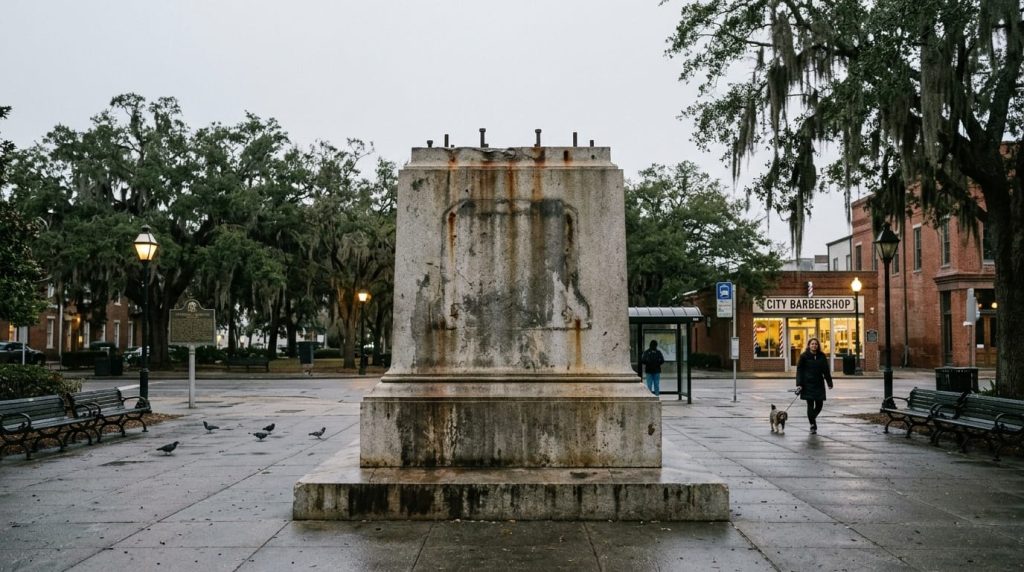
American monuments and public memory do not simply reflect the past; they actively shape it. Across cities, parks, and public spaces, statues and memorials tell a selective story about who matters and whose experiences define the nation.
These structures are not neutral; they are built through power, politics, and deliberate choice. By examining American monuments and public memory, we begin to see how history is curated, not just remembered. What is honoured, what is ignored, and who decides all reveal a deeper truth: public memory is constructed, contested, and constantly reshaped by those with the authority to define it.
Contents
How America Chooses What to Remember
America’s public monuments do not document history. They enforce a version of it.
In 1890, the citizens of Richmond, Virginia, gathered to dedicate a statue of Robert E. Lee. The speeches that day were confident, even celebratory. Civic leaders spoke of honouring valour, of teaching future generations what it meant to stand for principle. They were not, in their own minds, doing anything political. They were simply remembering.
That confidence is the subject of this blog.
Monuments do not remember. They instruct. They tell citizens who count as a protagonist in national life, whose sacrifices were legitimate, whose suffering was incidental, and whose story is so self-evidently important that it deserves to be rendered in bronze and installed at eye level in the centre of public space.
Every monument is a claim about what the past means and therefore about what the present should value. Dedication speeches rarely say this so plainly. They speak of heritage, of honour, of history. But the choices embedded in every monument that depicts, in what posture, on whose land, funded by whom, protected by which laws are political choices, made by people with interests, at moments when those interests were served by a particular version of the past.
This essay concerns statues, memorials, and named public spaces: the physical infrastructure of collective memory. Its argument is direct. The American monumental landscape is not an accumulation of neutral commemorations. It is the product of deliberate exclusion, sustained by legal and institutional structures designed to keep it exactly as it is. Understanding it requires asking not only who is remembered, but who decided, who paid, who benefited, and who has been required to live, for generations, beneath monuments built to diminish them.
The countercase is real and worth acknowledging: some monuments do emerge from genuine civic feeling, from communities that wanted simply to mark what mattered to them. But civic feeling has never been politically neutral. The feeling of a community that holds power and the feeling of a community excluded from it produce very different landscapes, and for most of American history, only one of those communities controlled the public square. What looks like organic commemoration is, on closer inspection, almost always the commemoration of the powerful by the powerful. The words that follow will show why.
Nothing about this landscape is accidental.
The Confederate monument campaign of the post-Reconstruction era was not grief made visible. It was a coordinated occupation of public space, funded largely by organisations like the United Daughters of the Confederacy and executed with deliberate strategic intent. The statues went up not in the immediate aftermath of the Civil War, when grief might have explained them, but in the 1890s and early 1900 sprecisely the decades when Reconstruction’s promise of Black political participation was being violently dismantled, when Jim Crow laws were being legislated across the South, when the message that Black Americans did not belong in civic life needed to be delivered as clearly and publicly as possible.
These monuments were not installed in cemeteries, among the dead. They were placed in courthouses, town squares, and public parks, among the living. They told Black Southerners, in marble and bronze, who this country belonged to.
The ideology underwriting them had a name: the Lost Cause. It held that the Confederacy had fought not to preserve slavery but to defend states’ rights, constitutional principles, and a noble way of life against Northern aggression. It held that enslaved people had been, on the whole, content. It held that the real tragedy of the Civil War was the defeat of Southern honour, not the continuation of human bondage, and that the men who fought to preserve that bondage deserved to be celebrated as heroes.
The Lost Cause was not a fringe position. It shaped school curricula, popular fiction, and political rhetoric across the country for the better part of a century. And it was prosecuted as effectively through public monuments as through any courtroom or legislature. A child who grew up in Richmond, looking at the Lee statue on Monument Avenue, was receiving a lesson. The lesson was a lie, but it was delivered with the full authority of civic permanence.
What is missing from most accounts of American public memory is the Gilded Age monument wave that followed. In the decades after the Civil War, as industrialists accumulated extraordinary wealth and political power, the monumental landscape of Northern cities filled with statues of founders, commercial titans, and military figures, funded by private fortunes and installed in public squares as though elite beneficence and civic virtue were one and the same.
The men who paid for these monuments were not neutral donors. They were participants in the political economy of their moment, and the figures they chose to honour and the ones they did not reflected their interests. Organised labour built this country as surely as any industrialist. The landscape did not say so.
Then, briefly, the logic was interrupted. The New Deal’s Works Progress Administration funded public art on an unprecedented scale, murals in post offices, sculptures in parks, and paintings in courthouses, created by working artists and depicting labourers, farmers, immigrant communities, and ordinary civic life. For a moment, public space made room for a different kind of protagonist. The interruption was real. It was also temporary. By the postwar period, the heroic and triumphalist register had reasserted itself.
The Lincoln Memorial arrived in 1922, its white marble columns and colossal seated figure establishing an aesthetic of governmental permanence that would define the National Mall for the rest of the century.
Mount Rushmore was carved between 1927 and 1941 into the Black Hills of South Dakotal and that the federal government had seized from the Lakota Sioux in violation of the 1868 Fort Laramie Treaty, land that the Lakota considered sacred and on it were carved the faces of four white presidents, including the man who had authorized the largest mass execution in American history, of thirty-eight Dakota men in 1862.
The monument celebrates westward expansion on the very ground that expansion destroyed. This was not an oversight. The people who authorised it knew where they were building. They decided the statement was worth making.
These choices accumulated into a landscape. By the mid-twentieth century, that landscape told a coherent story: America was built by white men of vision and courage; its founding violence was either incidental or justified; the people it displaced, enslaved, and excluded were background figures at best. The story was not argued; it was assumed, embedded in the granite and marble of public space, made to feel like a simple fact.
Monuments appear when a particular version of the past serves present power. That is the mechanism. Everything else is infrastructure for it.
Political will initiates the process. The Confederate statues did not rise spontaneously from collective grief. They were organised, funded, and lobbied for by specific groups with specific goals. The same is true of virtually every significant monument in American history. Someone decided this figure deserved commemoration. Someone raised the money. Someone secured the permits. Someone chose the location, the scale and the posture. These decisions were made by people, at particular moments, for reasons that can be identified and examined. Treating monuments as the natural expression of collective memory obscures the machinery that produces them.
Elite funding shapes the result. Wealthy patrons and organised heritage associations have historically held disproportionate influence over which figures receive civic consecration. Philanthropy and commemoration have always been entangled. The donor who funds a monument is not simply expressing personal sentiment; they are purchasing a form of cultural authority, the ability to determine what future generations encounter when they walk through public space. That authority has been distributed very unevenly.
Communities with money and political connections have left abundant traces in the monumental landscape. Communities without them have left almost none.
What keeps contested monuments standing is law. The National Historic Preservation Act and its state-level equivalents construct legal fortresses around designated structures, making removal procedurally exhausting and legally costly regardless of public will. This is not a neutral protection of history. It is a structural guarantee that the landscape remains frozen at the moment of its construction, a moment that reflected specific power arrangements and was then legally protected as though it reflected universal agreement.
When officials in Richmond spent years in court fighting over the Lee statue, what the law was protecting was not history but a particular political settlement, reached in 1890, that a different political settlement was now trying to undo. The legal system treated the older settlement as more legitimate simply because it was older.
The omissions are where the argument becomes undeniable. For most of American history, the monumental landscape contained almost nothing dedicated to enslaved people, to the victims of racial terror, to Native resistance, or to the contributions of immigrant labourers. This was not because these histories were obscure. The histories were known. The exclusion was deliberate. Public space was maintained as a site of legitimation for those who controlled it, and legitimation required a particular kind of story, one with heroes, not victims; progress, not atrocity; foundation, not dispossession.
The National Memorial for Peace and Justice, opened in Montgomery, Alabama, in 2018, did not fill a gap in the landscape. It exposed an architecture of exclusion that had been functioning quietly and effectively for generations. The memorial documents over four thousand racial terror lynchings that took place in the United States between 1877 and 1950, events that were not secret, that were often photographed and publicly celebrated at the time, and that left almost no trace in the official monumental record.
Walking through it, what visitors encounter is not simply tragedy. It is the shape of what was left out, and the realisation that the leaving out was a choice made continuously by generations of people who controlled public space and used that control to determine whose suffering counted.
Symbolism enforces hierarchy in ways that operate below conscious argument. The towering marble figure on a high plinth instructs the viewer to look up, to feel small before individual greatness, to understand that certain human beings occupy a different register of significance. Abstract forms operate differently: Maya Lin’s Vietnam Veterans Memorial, a wound cut into the earth rather than a soldier rising above it, constructs grief, ambiguity, and collective loss.
It does not instruct visitors to feel proud. It asks them to feel the weight of what was spent. The formal register of a monument communicates who deserves permanent honour and who deserves only acknowledgement, who is a hero and who is a casualty, whose story ends in triumph and whose ends in sorrow. These communications are not incidental to the monument. They are its primary function.
One further force shapes the landscape, and it is rarely named plainly: money. Contested monuments generate tourism. Cities weighing the removal of a well-known statue must calculate not only the moral argument but the economic one, the visitors who come to see it, the hotels and restaurants that benefit, and the tax revenue that depends on the controversy remaining productive rather than resolved. This calculation has a political aspect. It means that justice is regularly deferred to economics, and that the communities most harmed by a monument’s presence are least likely to hold the economic leverage required to force its removal. Naming this is not cynicism. It is accuracy.
The summer of 2020 did not start a new debate. It forced an existing one into the open.
In the weeks following George Floyd’s murder on May 25, as protests spread to every major American city and to countries across the world, something happened to the monumental landscape that had seemed, for decades, immovable. Statues came down. In Bristol, England, protesters pulled a statue of slave trader Edward Colston from its plinth and rolled it into the harbour.
In Belgium, statues of King Leopold II, under whose rule an estimated ten million Congolese people died, were defaced and removed. In the United States, over a hundred Confederate symbols were taken down in the span of a few months: by municipal governments moving faster than they ever had before, by state legislatures that had resisted for years, and in some cases by protesters who did not wait for official permission. The speed was startling.
It revealed something that the monuments’ defenders had always denied: the permanence was not structural. It was political. The monuments had survived not because their case was strong, but because the cost of removal had been artificially kept high.
The debate that surrounded these removals was often reduced to a binary preservation versus erasure that obscured more than it clarified. Preservationists argued that monuments, however uncomfortable, are historical records and that removing them is a form of censorship, an attempt to pretend that the history they represent did not happen. This argument has surface plausibility, but it rests on a confusion.
A monument is not a historical record in the way an archive is. It is a civic statement. Installing a figure in a position of honour in a public square is not the same as documenting that the figure existed. It is a claim that the figure deserves honour, and that claim can be wrong. Removal does not erase the history of Robert E. Lee. It withdraws the civic endorsement of him. Those are different acts.
Removal advocates made a simpler and, on examination, stronger argument: a monument installed in a position of civic honour is an ongoing political statement, not a historical artefact, and its continuation causes ongoing harm to the communities who live beneath it.
This argument takes seriously something the preservationist position does not: that public space is not neutral, and that its effects on the people who move through it are real. A Black child in Richmond who grew up beneath the Lee statue on Monument Avenue was not simply encountering history. She was being told something about her place in civic life. That telling was the monument’s function. It was functioning as designed.
Germany made a different decision. After 1945, the Federal Republic made a deliberate choice to build almost no monuments honouring Nazi figures or military leaders. The landscape instead is filled with memorials to victims: the Memorial to the Murdered Jews of Europe in Berlin, stumbling stones embedded in sidewalks across the country, bearing the names of individuals deported and killed.
Germany did not erase its history. It built a different kind of monument to it, one that centres accountability rather than honour, grief rather than pride. The result is a public landscape that makes it nearly impossible to move through German cities without encountering the weight of what the country did. This was a deliberate political choice, and it has shaped how Germans understand their national identity in ways that remain contested and productive.
South Africa has not resolved its equivalent question. Colonial-era statues remain standing in some cities and have been removed in others. The debate continues. The point is not that either country provides a model that America should simply adopt, but that the American position, a landscape largely frozen at the height of white supremacist monument-building, legally protected and economically defended, is a choice, not an inevitability. Other choices are possible. Some have been made.
The Columbus question sits at the edge of the debate because it resists the framework that makes Confederate monument removal relatively straightforward. Robert E. Lee fought to preserve slavery. The argument against honouring him is not difficult to make. Columbus represents something older and more foundational: the originating act of colonisation, the beginning of the process that made the United States possible and that destroyed the civilisations that preceded it.
The question his statues pose is whether any monument can be contextualised into acceptability, whether a plaque that acknowledges genocide alongside a figure who inaugurated it constitutes honest commemoration or simply a more sophisticated form of denial. There is no clean answer. The debate is worth having precisely because it forces the question that the blog has been circling: not whether specific monuments should stand or fall, but what public commemoration is actually for.
Four monuments clarify what the abstract argument means in practice.
The Robert E. Lee statue in Richmond, Virginia, was erected in 1890, at the height of the Lost Cause’s political effectiveness, and it stood for one hundred and thirty-one years. During that time, it was designated a war memorial, granted state protection, made the subject of a specific Virginia law prohibiting the removal of war memorials, and defended through multiple rounds of litigation by the state government and by heritage organisations with significant legal resources.
When Richmond’s mayor announced his intention to remove it in June 2020, the legal battle that followed lasted over a year. The statue was finally taken down in September 2021, after the Virginia Supreme Court ruled that a 1997 deed restriction protecting it did not apply.
What the Lee statue’s story demonstrates is not that removal is possible. It is designed to be exhausting. Every legal protection, every procedural barrier, every funding mechanism for litigation is a way of raising the cost of change until the political will to pursue it collapses. The communities most harmed by the monument’s presence are least likely to have the resources to sustain a years-long legal campaign. The system is not neutral. It is weighted toward the landscape it inherited.
The Martin Luther King Jr. memorial in Atlanta, dedicated in 1980, met little organised opposition, a fact that deserves scrutiny rather than simple celebration. King’s stature made him politically unassailable by 1980, but the memorial’s framing matters. It commemorates King as the champion of a civil rights movement that succeeded, that delivered on its promise, that belongs to a completed chapter of American history.
What it does not foreground is what King was actually arguing in 1968: that the civil rights legislation of the mid-1960s had been necessary but insufficient, that economic inequality and the Vietnam War were as urgent as legal segregation, that America had not yet begun to grapple with the depth of what it owed its Black citizens. A monument to the King that presents his legacy as triumph rather than unfinished demand is not simply an act of honour. It is a form of containment, a way of commemorating the version of King that is easiest to absorb and setting aside the version that remains most challenging.
The Emancipation Memorial in Washington, D.C., is the monument that most productively refutes the blog’s arguments. Dedicated in 1876, it was funded entirely by contributions from formerly enslaved people. The first monument on the National Mall, paid for by Black Americans, depicts Abraham Lincoln standing with his right hand extended over a kneeling Black man, his chains broken but his posture submissive, his eyes cast downward.
Frederick Douglass, who spoke at the dedication, expressed private reservations about the imagery even as he praised the monument’s existence. In recent years, calls for its removal have grown, and they have come from Black scholars and activists, among others, who argue that, whatever the funding source, the image of a Black man on his knees before a white president is one that should not occupy a position of civic honour.
The debate that has followed is marked by sharp disagreement among Black community members. Some argue that the monument’s origin, paid for by people who had themselves been enslaved, as an act of self-determined commemoration, cannot be separated from its imagery, and that removing it would erase a form of Black agency that is itself historically significant.
Others argue that the imagery is what viewers encounter, that symbolism operates regardless of intent, and that the kneeling figure instructs all who see it in ways that no historical footnote can fully counteract. There is no resolution available that satisfies everyone, because the monument embodies a genuine tension: between the conditions under which formerly enslaved people were able to exercise public commemorative power in 1876 and the representational standards a more just landscape would demand.
Sitting with that tension, rather than resolving it too quickly, is the honest intellectual position. The Emancipation Memorial does not tell us what public memory should look like. It tells us how difficult it is to produce, under conditions of inequality, a memory that is fully one’s own.
The National Native American Veterans Memorial, completed on the grounds of the National Museum of the American Indian on the National Mall in November 2020, after decades of advocacy and legislation, is the simplest and in some ways the most damning of the four cases. Indigenous Americans have served in the United States military at higher rates per capita than any other demographic group.
This was not a hidden fact. It was documented, acknowledged in congressional testimony, and recognised in official reports. The absence of any national monument to that service was not an oversight. It was a choice, a choice to maintain a landscape in which Native Americans appeared primarily as the subjects of conquest rather than as citizens with claims on national commemoration.
The memorial’s eventual arrival is not a resolution of that history. It is evidence of how much sustained pressure, how many decades of advocacy, how many failed legislative attempts, and how much organised political effort are required to break open a landscape designed to hold its shape.
A public landscape full of triumphant generals and founding fathers does not merely reflect existing hierarchies. It constructs them, continuously, in every citizen who learns to read public space as a guide to who matters. This is why the debate about monuments is not, at its core, a debate about history. It is a debate about civic education: what story public space tells children as they are still forming their understanding of the kind of country they live in and the kind of people they might become within it.
Reform proposals deserve serious engagement rather than simple endorsement. Community-led commissions are frequently invoked as the solution; they require definition before they can function as one. Who constitutes the community?
In a city like Richmond, where the question of the Lee statue divided residents along lines of race, class, and political affiliation, the appeal to community consensus can dissolve into a mechanism for paralysis. Who adjudicates competing claims?
Who determines what counts as a legitimate community interest and what counts as obstruction?
Without answers to these questions, community-led processes can disperse accountability rather than exercise it, producing the appearance of democratic deliberation while leaving contested monuments exactly where they are.
Contextual plaques have been implemented across the country with genuinely mixed results. At their best, they can complicate a monument’s meaning, provide information that changes how viewers encounter it, and acknowledge histories that the monument itself excludes. At their worst, they function as political cover, a way of demonstrating responsiveness to criticism without accepting its premise, preserving the monument’s position of civic honour while adding a footnote acknowledging its problems.
A plaque on a Confederate monument that explains its context does not transform it into an educational resource. It leaves a statement of white supremacist civic pride in place and adds a small qualification. Whether that is honest commemoration or sophisticated denial is a question each community must answer for itself, but it should answer it directly, not treat the plaque as a resolution when it may be a deferral.
Digital archives and memorials offer genuine value by expanding access to suppressed histories and making visible the stories the physical landscape excludes. They should be pursued and resourced. But they should be understood as supplements to physical public memory, not substitutes for it.
A monument that moves online has not been reckoned with. It has been managed. The experience of encountering a physical monument in public space, its scale, its permanence, and its location at the centre of civic life is categorically different from encountering a digital record. Physical presence makes a claim. Digital presence documents one. These are not the same thing, and treating them as equivalent is a way of resolving the political problem by changing the subject.
The strongest objection to monument removal is not that the monuments are right. It is that the logic of removal has no principled stopping point that once democratic majorities are empowered to revise the public landscape based on current values, every figure in the monumental record becomes subject to the politics of the moment, and the landscape loses the stability that makes it legible as a shared civic inheritance.
This argument has genuine force. It has also been consistently deployed to protect monuments that were themselves the product of deliberate political intervention, installed through organised campaigns at specific historical moments for specific political purposes. The current landscape did not arise from a neutral accumulation of universal civic values. It was built by people with interests, locked in place by law, and defended by those whose sense of civic identity it confirms. Calling it stable does not make it neutral. The question is never whether the landscape should reflect values; it always does, but whose values it reflects, and whether those values can withstand honest examination.
Return to Richmond in 1890. The speeches are confident. The statue gleams. The civic leaders are certain they are teaching the right lesson to the future. They are. The lesson is about power: who holds it, what stories it tells about itself, how thoroughly those stories can be made to look like simple facts.
The Lee statue stood for one hundred and thirty-one years, not because its argument was sound, but because the power that erected it had enough institutional depth to protect it long after the argument collapsed. When it finally came down, the question it left behind was not whether Robert E. Lee deserved a monument. That question had been answered. The question was: why did it take so long, what it cost to answer, and how many similar questions remain unasked in public squares across the country.
Every monument in American public space is a decision that someone made, at a particular moment, for particular reasons, using available power to define what the future would be required to look like. Some of those decisions were made in confidence, as in Richmond in 1890.
Some were made in struggle, like the formerly enslaved people who pooled their money in 1876. Some were made in bad faith. Some were in good faith, but turned out to be insufficient. All of them produced the landscape that exists today, a landscape that is still being contested, still being revised, still making claims on the people who move through it.
The monument you pass without looking is still instructing you. That is the point. The question is whether you have decided what to do with the lesson.
Leave a Reply