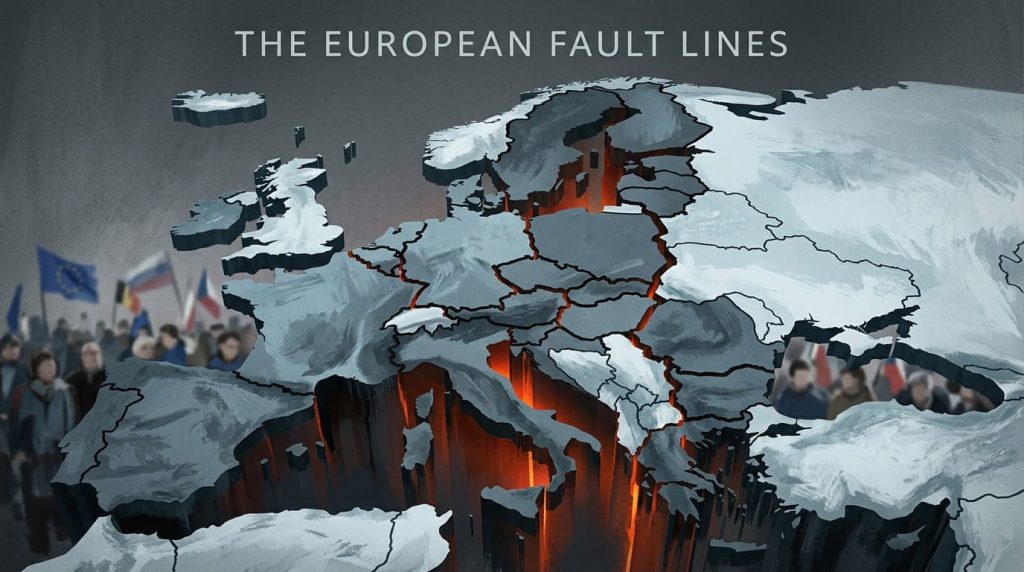
European populism 2026 is not a sudden rupture in democratic politics but the visible surface of a deeper institutional breakdown. Across the UK, France, Germany, and the wider European Union, political systems that once claimed stability now struggle to command trust or deliver outcomes.
This moment is best understood not as a rise of extremism alone, but as a response to accumulated failures in governance, representation, and economic fairness. Populist movements have not created these conditions; they have exposed them. To understand European populism, 2026 is to confront the underlying weaknesses that made it not only possible, but inevitable.
Contents
Country Case Studies
Populism is not an ideology. It is a political logic that divides the social world into two antagonistic camps, a pure and betrayed people on one side, a corrupt and self-serving elite on the other, and demands that politics be understood as the conflict between them.
That logic is available to the left and to the right. On the right, it takes a nativist form: the people are defined culturally, the elite betrays them through immigration, globalisation, and cosmopolitan indifference to national identity.
On the left, it takes a redistributive form: the people are defined economically, the elite betrays them through austerity, financialisation, and the capture of democratic institutions by capital. Both variants are present in contemporary Europe. Both are responses to the same underlying failure. Understanding that failure is the task of this blog.
The historical arc is familiar in outline but consistently misread in meaning. The 2008 financial crisis did not cause European populism; it provided its first major proof of concept. When the banks failed and were saved, when austerity was imposed on populations that had not caused the crisis and did not consent to bearing its costs, when the political centre across Europe absorbed the shock and continued largely unchanged, a lesson was delivered to millions of voters: the system is not neutral. It has beneficiaries, and you are not among them.
The migration waves of 2015 and 2016 added a second layer, not simply the numbers, which most European states were structurally capable of managing, but the spectacle of governments that appeared to have lost control of a basic function of sovereign statehood. Brexit followed as the first successful institutional expression of this accumulating fury: not a policy disagreement, but a vote of no confidence in the political class delivered by constitutional means.
COVID administered the final stress test, and the results varied, but in most European states, what was revealed was a public health infrastructure degraded by a decade of austerity, a political class that oscillated between incompetence and authoritarianism, and a population that had been asked to trust institutions it had already largely stopped believing in.
The thesis of this blog is stated plainly: Europe’s 2026 populist surge is not a disruption of democratic normality. It is evidence that democratic normality had already broken down. Populism does not hollow out institutions. It moves into institutions that are already hollow.
The states where it has advanced furthest are not those that faced the harshest objective crises, but those whose political classes were most thoroughly disarticulated from the populations they claimed to represent and had been for years before the first populist party achieved an electoral breakthrough. This is a more troubling conclusion than the standard account, because it locates the problem not in the populists but in the conditions that made them the most honest political language available to a significant portion of the European electorate.
The Structural Conditions
Three interlocking conditions made European states legible to populist politics by 2026, and they must be understood as a system rather than a list.
The first is economic precarity. Post-pandemic inflation and the cost-of-living crisis of 2022 to 2024 were not merely painful; they were experienced as a revelation. Real wages fell across most of Europe while corporate profits recovered. Energy price rises hit the bottom half of income distributions with a force that the top half, insulated by assets, did not feel.
Deindustrialisation in legacy regions, the former coalfields of northern England, the post-reunification east of Germany, and the peripheral cities of southern France had been proceeding for decades, but the political economy of the 2010s stripped away the social infrastructure that had historically cushioned it. What remained were communities that had lost their economic rationale, their public services, and their political representation simultaneously.
When parties that claimed to speak for these communities spent a decade administering the same technocratic consensus regardless of which side of the political spectrum they nominally occupied, the conclusion voters drew was not that the policies were misjudged. It was that they themselves were not the intended constituency of democratic governance.
The second condition, political alienation, is distinct from economic grievance and should be treated separately. Alienation is not about material deprivation alone; it is about the perception that the political system is structurally unresponsive to you, regardless of how you vote. This perception had a factual basis.
Across Europe, the convergence of centre-left and centre-right parties on economic fundamentals central bank independence, balanced budgets, labour market flexibility, managed globalisation produced party systems in which the choice between governing options had narrowed to questions of managerial competence and social liberalism, while fundamental questions about redistribution, sovereignty, and the terms of economic life were placed outside the democratic arena by treaty, by technocratic norm, or by the implicit consensus of the political class.
The EU, whatever its genuine achievements, became the institutional symbol of this narrowing of a structure in which consequential decisions were made by bodies that no national electorate could remove, in a register of expertise that systematically delegitimised political objection as ignorance or sentiment.
The third condition is cultural anxiety, and it requires careful treatment. It is tempting to dismiss it as the ideological cover for economic resentment, and there is evidence that economic and cultural grievances correlate. But the cultural dimension has its own logic.
Questions of national identity, immigration, and the pace of social change are not simply proxy expressions of wages and job security; they are genuine political claims about belonging, recognition, and the terms of community life. When progressive politics, particularly in its institutionalised forms, treated these claims as inherently suspect as racism dressed up, as nostalgia weaponised, it did not dissolve them. It drove them toward the only political formations that would acknowledge them as legitimate. Populism won the argument about cultural anxiety not because it had better answers but because it was willing to have the conversation at all.
These three conditions, however, do not fully explain the velocity and intensity of Europe’s 2026 populist moment without a fourth factor that is too often treated as a communication problem rather than a structural transformation: the algorithmic reorganisation of political reality.
Populism is not merely amplified by social media. It is the first political form fully native to algorithmic systems. The attention economics of digital platforms do not simply prefer emotional content; they structurally punish complexity and reward binary conflict. The populist worldview, with its clear enemy, its betrayed people, and its simple remedy, is not one option among many in the digital media environment.
It is the option that the architecture of that environment continuously selects for and rewards. Political reality is no longer primarily constituted by institutions, parties, or broadcast media, but by feeds curated to confirm and intensify existing grievances. This does not make populism’s claims true, but it makes them feel true in a way that institutional rebuttals, delivered through press conferences and policy documents, cannot effectively contest. Any analysis of contemporary European populism that relegates this factor to a section on social media has fundamentally misread the phenomenon it describes.
Left-wing populism, Mélenchon’s France Insoumise, Corbynism in Britain, and the early phases of Podemos in Spain must be held in frame throughout this analysis. Its presence establishes the blog’s central structural claim: the conditions producing populism are not ideological. They are conditions of representational failure, and they produce political responses across the entire spectrum. The left and right variants propose incompatible remedies, which is why they tend to compete for the same disaffected electorate without combining into a transformative force. Their shared root in the crisis of political representation is precisely what the essay must explain.
The United Kingdom State Failure as Political Verdict
The United Kingdom is the blog’s sharpest case, because in Britain the underlying argument becomes most legible. What happened here was not an ideological revolution, not a turn to the right, not a cultural backlash, at least, not primarily. It was a competence collapse so total and so prolonged that a significant portion of the electorate stopped asking which party offered better policies and started asking whether the British state retained the capacity to govern at all. That question, once it enters the political atmosphere, is extraordinarily difficult to remove. It is the question that populism answers loudly and poorly, in the absence of credible competition.
Brexit was the accelerant, not the originating cause. Its importance was not as a policy; reasonable people continue to disagree about whether Britain’s departure from the EU was economically damaging, geopolitically reckless, or an expression of legitimate democratic self-determination, but as a constitutional event that normalised a set of political behaviours previously contained by informal convention.
The idea that parliamentary procedure could be prorogued for political convenience, that the rule of law was an establishment weapon rather than a democratic protection, that expertise was a form of elite condescension, that the political mainstream was a monolithic and self-interested bloc, these ideas did not originate with Brexit, but Brexit mainstreamed them.
What followed was not a series of unrelated failures but a single extended demonstration of institutional disintegration: the Johnson government’s systematic assault on civil service independence and parliamentary norms; partygate, which revealed that those imposing pandemic restrictions considered themselves exempt from them; the Rwanda policy, which spent hundreds of millions of pounds over several years without removing a single asylum seeker; the Truss budget, which crashed the currency in a matter of days through the sheer force of ideological wishful thinking; the slow-motion decay of the National Health Service, the courts, the housing market, and the other public systems whose visible deterioration became the daily texture of British life.
Reform UK is the political expression of this accumulated verdict, and it should be understood as such rather than as a movement with a coherent ideological programme. Its voters are not primarily motivated by a detailed policy agenda. They are motivated by the conviction that the available options have been tried and found contemptible, that the Conservatives were exposed as self-dealing and incompetent, and that Labour, whatever its intentions, represents essentially the same political class in slightly different clothing.
Nigel Farage’s genius, and it is a genuine political genius, is not programmatic but diagnostic. He names the feeling of institutional betrayal and offers himself as its expression. That is sufficient in a political environment where the competition for that space is the establishment parties, most of which are responsible for creating it.
Labour’s repositioning under Keir Starmer has not resolved this dynamic. It has partially displaced it. Starmer’s political project is managerial rather than transformative, a restoration of governmental competence rather than a reconstruction of the political economy that produced the crisis. This may prove adequate, and it would be wrong to dismiss competent governance as a trivial achievement given the preceding years. But it does not address the underlying causal chain, which runs cleanly from state failure through trust collapse to the search for political forms outside the mainstream.
Until the first link is addressed, until the state demonstrably delivers, over a sustained period, for the communities that have concluded it does not govern for them, the others follow automatically. Populism in Britain is not an interruption of normal politics. It is normal politics for a large portion of the electorate, in conditions of institutional failure.
France: The Geography of Abandonment
France illustrates something the British case leaves implicit: that populism has a precise spatial logic, and that understanding its geography is necessary for understanding its politics.
The National Rally’s support is not distributed evenly across the French population. It is concentrated with remarkable consistency in France that Paris forgot peripheral, rural, deindustrialised, culturally conservative communities that have watched their local hospitals close, their high streets empty, their railway connections discontinued, and their young people leave for cities that do not particularly want them either.
These communities have reached a conclusion that, given the evidence available to them, is not irrational: the French republican state, whatever it says about égalité and fraternité, governs in the interests of the metropolitan educated class, and deploys universalist language as an aesthetic cover for that preference.
Marine Le Pen and Jordan Bardella did not create this geography. They found it and have spent 20 years building a political organisation capable of harvesting it.
Emmanuel Macron is the blog’s most instructive individual figure, because his failure is not one of policy in the conventional sense; he has passed significant reforms and maintained a coherent, if contested, vision of France’s place in Europe, but not of political grammar. A president who described those outside elite professional networks as “those who are nothing,” who pushed pension reform through parliament without a vote when he lacked the numbers to pass it democratically, and who embodied meritocratic self-confidence as an aesthetic and a governing style, Macron generated populist energy not despite his intelligence and competence but through them.
The lesson is precise: technocratic ability, presented without democratic humility, reads as contempt. And contempt, in a political environment where half the electorate already believes the political class does not recognise their existence, is extraordinarily costly. By treating the republican consensus as so obviously correct that opposition to it could only represent ignorance or bad faith, Macron gave Le Pen a gift she could not have purchased with policy.
France Insoumise and Jean-Luc Mélenchon complicate the picture in the way the theoretical framework predicts. The same geographic and economic abandonment that produces National Rally voters in peripheral France produces France Insoumise voters in the post-industrial suburbs and among the younger urban precariat.
Both movements are expressions of the same elite-periphery fracture, offering incompatible solutions: nativist cultural restoration on one side, radical redistribution on the other, to a shared experience of political non-representation. The result is a political arithmetic in which the centre holds formal power while commanding the genuine allegiance of a shrinking minority. French politics has become structurally ungovernable, not because extremists have taken over but because the political centre has lost the moral authority to set the terms of political possibility.
The civil unrest over pension reform, the repeated crises over laïcité and the headscarf, and the yellow vest movement that preceded the current conjuncture are not separate phenomena requiring separate explanations. They are manifestations of the same underlying pressure: a population experiencing the gap between the republic’s promises and its performance, with diminishing faith that those currently in power will close it.
Germany: The Ambiguity of Resilience
Germany poses the most uncomfortable question of the four cases, and the blog should resist the temptation to resolve it too quickly. If a country possesses strong democratic institutions, a written constitution explicitly designed to prevent democratic self-destruction, genuine historical memory of where authoritarian politics leads, a vigorous free press, an independent judiciary, and a federal structure that distributes power and populism advances significantly anyway, what exactly are these institutional safeguards protecting against, and how much confidence should we place in them?
The AfD’s rise is concentrated in the east and must be understood in its specific historical context. The reunification of 1990 was experienced in large parts of the former German Democratic Republic not as liberation but as annexation, an absorption into a West German political economy and cultural framework that simultaneously dissolved existing social structures, produced mass unemployment, and imported a political class that treated eastern disorientation as ingratitude.
The sense that eastern Germany has been governed by and for western German interests for three decades provides the AfD with a grievance that predates immigration, predates the energy transition, and predates the specific political conjuncture of the 2020s. Migration anxieties and the economic disruptions of the post-COVID period have intensified and broadened this base, but the foundation is older and more durable than these proximate causes.
The east-west divergence in German political culture, with the AfD routinely achieving pluralities in eastern state elections while remaining a minority force in the west, is not a communication problem. It is a structural legacy of reunification that the German political mainstream chose to manage rather than address.
The AfD’s classification by Germany’s domestic intelligence service as a proven extremist organisation, a designation with significant implications for party financing, civil service membership, and potential banning proceedings, represents the German state’s attempt to use its constitutional architecture to contain what it cannot dissolve through politics. The result illuminates a gap that Germany alone among the blog’s cases makes fully visible: the gap between legal containment and political reality.
Classifying the AfD does not reduce the grievances that produce AfD voters. It may intensify them in some communities, providing further evidence for the claim that the establishment uses institutional power to suppress legitimate political expression. Germany’s constitutional resilience is real and consequential; it has prevented the AfD from achieving the governing positions that equivalent parties hold elsewhere, but it has not immunised Germany against the conditions that make those parties appealing.
Germany also carries a burden that adds a dimension absent from the British and French cases: it is simultaneously managing its own internal populist pressure and functioning as the indispensable underwriter of European stability. German domestic politics are consumed by the question of how to respond to the AfD, which is siphoning off German political energy from the construction of European security architecture, climate policy, or fiscal solidarity. When populism succeeds in large states, it does not remain a domestic phenomenon. It radiates.
Beyond the Big Three: Normalisation, Reversal, and the EU Itself
Cases beyond the three major states are analytically essential because they expand the range of outcomes the blog must account for.
Italy under Giorgia Meloni represents the normalisation trajectory: a party with post-fascist genealogy governing pragmatically within EU constraints, maintaining Italy’s commitments to NATO and the eurozone, and managing migration policy within the broad parameters of European political normality, even when contested.
Meloni has demonstrated something important: institutional responsibility can redirect, and perhaps partially domesticate, populist energy. She has also demonstrated something troubling: that a party need not abandon its ideological formation to achieve and maintain governmental power. Whether the Italian case represents democratic resilience, in which institutions successfully constrain the expression of populist impulses, or successful institutional capture, in which a movement with anti-democratic instincts acquires the legitimating cover of democratic office while gradually reshaping the norms within it, is a question that should be left genuinely open.
Hungary under Viktor Orbán is the complete case of illiberalism as a settled governing project rather than an aspiration. What Orbán has built is not a classical dictatorship. It is a competitive authoritarian system, in which elections occur, opposition parties exist, and formal democratic structures are maintained, while the independent institutions that give those structures substance, the judiciary, the press, civil society, and the universities are systematically subordinated to the governing party’s interests. The lesson Hungary offers is not that democracy can be overthrown. It is that it can be emptied while its external form is preserved, and that this process, once sufficiently advanced, is extremely difficult to reverse.
Poland is the indispensable counter case, and the most instructive in certain respects. The Tusk government’s attempt since 2023 to reverse the democratic backsliding of the Law and Justice years has revealed, with uncomfortable clarity, how much institutional damage accumulates in a relatively short period and how slowly legal and constitutional repair proceeds.
Courts packed with loyalists cannot be simply repacked in the opposite direction without replicating the methods that caused the problem. Public broadcasting captured by the governing party cannot be instantly restored to independence without a period of contested legitimacy. The norms and conventions that democratic institutions depend upon are not written down, and once broken, the act of restoration requires navigating their absence. Poland demonstrates that defeating populism electorally is necessary but nowhere near sufficient for democratic recovery. It is the beginning of a much longer and more uncertain process.
The European Union must be treated in this analysis as an actor, not merely a backdrop or an abstract reference point. The rightward shift in the European Parliament following the 2024 elections produced a legislature in which populist and nationalist parties hold genuine influence over legislative outcomes and institutional appointments. This is qualitatively different from the pre-2024 situation, in which populists exerted pressure on EU institutions from outside. They are now, in significant measure, inside those institutions.
The question of European democratic legitimacy, which has always been contested, has become acute. An institution that derives its authority partly from its commitment to liberal democratic values cannot indefinitely accommodate parties that contest those values from within without forcing a reckoning over what it stands for and who it represents.
Synthesis
The four cases are sufficiently different in their political systems, historical memories, and specific conjunctures that genuine cross-case comparison is possible, and three findings emerge that could not be visible from any single case alone.
The first is that populism’s advance correlates not with the objective severity of a crisis but with the perceived absence of a credible political response to it. Hungary in the 2000s, Britain in the 2010s, and France across both decades, the common factor is not the scale of the economic disruption or the intensity of the migration pressure but the failure of the governing political class to demonstrate that it was attempting to address these conditions on behalf of the populations experiencing them.
This is a finding about political representation rather than policy. It is possible to have wrong policies and retain democratic legitimacy, as long as the political system convincingly demonstrates that it is genuinely trying. What destroys legitimacy is the appearance, however justified or unjustified, that the political class is not trying, or is trying for someone else. Populism moves into the space created by that perception and fills it with a counter-narrative of betrayal that, once accepted, is difficult to dislodge with evidence alone.
The second finding concerns the relationship between left and right populism. The two variants are not simply different expressions of the same phenomenon; they compete for the same electorate of the disaffected, propose incompatible solutions, and tend to prevent rather than reinforce each other.
In France, the presence of both France Insoumise and the National Rally does not produce a unified anti-establishment movement; it produces a paralysed centre surrounded by mutually hostile flanks. In Britain, the space for left populism was partially occupied by Corbynism before its electoral collapse, and its failure may have permanently ceded that space to the right.
The interaction between left and right populism is not additive but competitive, and the conditions that produce both simultaneously are conditions of political incoherence rather than revolutionary transformation. This should complicate simple narratives of a populist takeover. The reality is more chaotic, and therefore in some ways more stable than it appears, because the energies cancel rather than combine.
The third finding concerns institutional resilience. Germany’s constitutional architecture has genuinely mattered; the AfD has not achieved the governing positions that equivalent parties hold in Italy, Hungary, or France. Britain’s unwritten constitution and informal norms offered almost no friction to the normalisation of populist rhetoric within governing parties, and the results are visible.
Poland’s institutional recovery is proceeding more slowly than its political reversal, because institutions are easier to degrade than to repair. The lesson is not that institutions are irrelevant. It is necessary and insufficient. No institutional design addresses the underlying conditions, the economic geography of abandonment, the algorithmic restructuring of political reality, and the trust deficit accumulated through decades of managed decline that make populations receptive to populism in the first place. Institutions can constrain the expression of that receptiveness. They cannot dissolve their causes.
Future Scenarios
Three trajectories are available to European democracy, and they are not equally likely. Their conditions are already partially visible in the current evidence.
Centrist renewal requires mainstream parties across Europe to do something that is structurally difficult and politically costly: acknowledge, concretely rather than rhetorically, that the communities that have turned to populism have legitimate grievances that deserve policy responses rather than demographic management.
This means rebuilding public services in deindustrialised regions, taking the social costs of rapid demographic change, reforming EU governance to produce outcomes that are visibly connected to democratic accountability, and perhaps most difficultly, maintaining these commitments through electoral cycles long enough for the populations that have lost faith to regain it.
The electoral incentives for this are currently weak almost everywhere. Politicians face short-term pressure to appeal to the median voter, and the communities most alienated by mainstream politics are often the least electorally efficient to target. Centrist renewal is possible. It requires political courage, which is demonstrably in short supply, and it operates on a timescale of a decade at minimum, which electoral politics makes extremely difficult to sustain.
Managed illiberalism is the trajectory on which several European states are already partly embarked. It does not announce itself. It proceeds through the gradual subordination of independent institutions to governing party interests, the narrowing of media pluralism, the delegitimisation of judicial oversight as undemocratic interference, and the redefinition of opposition as disloyalty. It is compatible with regular elections and formal democratic procedure.
Its danger is precisely its gradualism: each individual step is defensible, the cumulative direction is not visible until it is quite advanced, and by the time it becomes undeniable, the institutional capacity to reverse it has already been compromised. Italy is at an early stage of this trajectory, or possibly not on it at all. The ambiguity is genuine. Hungary has completed it. Several other European states are closer to the Hungarian end of this spectrum than their governing parties would acknowledge.
EU fragmentation does not require a single rupture, a state leaving the union, a treaty collapsing, or a dramatic confrontation between Brussels and a member government. It can proceed as a gradual differentiation in which the formal structure of the union persists while its political coherence dissolves.
A union in which populist and nationalist parties hold enough seats in national governments to prevent meaningful collective action on climate, migration, defence, and fiscal solidarity is a union that exists legally but not politically. A two-speed Europe is already partially visible in varying rates of integration, in accumulated opt-outs over decades, and in the basic fact that the euro area and the EU are different things.
The question is whether this differentiation stabilises at a manageable level of complexity or continues toward a condition in which the union can no longer perform its core functions. The indicators to watch over the next two years are the legal and electoral trajectory of the AfD in Germany, the legislative arithmetic in France following the next election, the pace of Polish institutional recovery, and the composition and political alignment of the next European Commission. These variables will not determine the outcome, but they will significantly narrow or widen the range of possibilities.
Conclusion
The evidence from Britain, France, Germany, and the broader European landscape supports and sharpens the thesis stated at the outset. Populism in 2026 is not a disease that infected healthy democratic systems from outside. It is a symptom of conditions that those systems generated internally through decades of economic abandonment, institutional self-dealing, the gradual narrowing of democratic possibility, and the failure to maintain the basic social contract that democratic legitimacy ultimately depends upon.
The political class now facing a populist challenge is, in most European states, the one that created the conditions for it. This is not a comfortable observation, but intellectual honesty requires it.
The finding that should disturb the reader is not that populism has advanced. It is what the advance reveals about the prior condition of European democracy. If populism moves into institutions that are already hollow, then the hollowness preceded the populism. The trust deficit was already there. The geographic abandonment was already there. The sense that democratic governance was conducted for the benefit of the networked and the credentialed, while the rest managed as best they could, was already there. Populist parties did not manufacture these perceptions. They found them, named them, and offered themselves as their expression. This means that the defeat of any particular populist party resolves nothing.
If the structural conditions persist, the economic geography of abandonment, the algorithmic media environment that makes grievance more legible than policy, the hollowed institutions that cannot deliver the basic expectations of democratic governance, then removing the current populists guarantees only the production of the next ones. Possibly angrier. Possibly more competent. Possibly less interested in the formal democratic constraints that this generation of populist leaders has, at least in most cases, partially respected. The electoral defeat of populism without structural reform is not a solution. It is a postponement, and a politically expensive one, because it confirms the populist claim that the system can absorb any challenge without genuinely changing.
The question European democracy faces in the years immediately ahead is not how to win elections against populist parties. It is whether its institutions retain the capacity for self-renewal that would make populism politically unnecessary, and whether they can, after everything, demonstrate to the populations that have abandoned faith in them that democratic governance is worth the faith it requires. The evidence examined in this blog does not permit easy optimism on that question. It permits, at best, the conclusion that the outcome remains open, and that what happens next will depend less on the populists themselves than on the choices made by the political establishments that created the conditions for their rise. That is where the responsibility lies, and that is where the work of democratic renewal, if it is to happen at all, must begin.
Leave a Reply