Contents
Why Everything Is Getting More Expensive
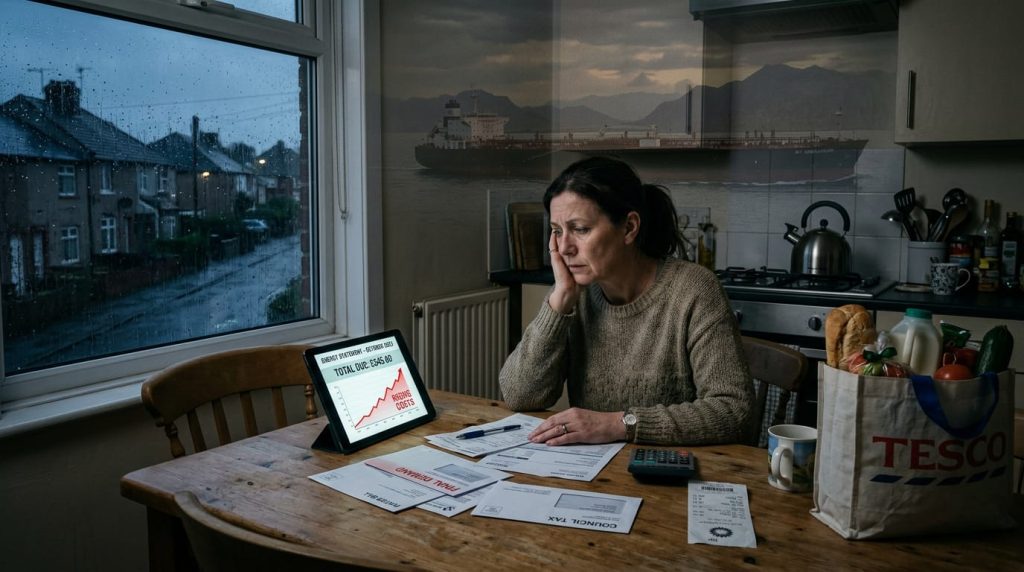
The UK cost of living crisis is rising again, just as many thought the worst had passed. Prices across the country are climbing from fuel and food to energy bills, leaving households under renewed pressure. What makes this moment confusing is how sudden it feels.
Only months ago, inflation appeared to be easing, offering hope of stability. Now, that optimism is fading. The reality is that this shift is not just about domestic policy but global forces reshaping everyday life in Britain.
To understand why prices are rising again, we must look beyond the UK and examine the deeper economic chain reaction.
Just when it seemed the cost-of-living crisis was easing, it’s back—and rising fast.
Across the UK, prices are climbing again. Petrol costs more. Food bills are creeping up. Energy prices are heading in the wrong direction. For many households, it feels like the pressure never really left—only paused.
So what’s changed?
The answer lies far beyond Britain’s borders.
The Real Trigger: War and Energy
The latest surge in prices is being driven by instability in the Middle East, particularly involving Iran. Even without full disruption, the threat alone has pushed oil prices above $110 a barrel.
At the centre of this is the Strait of Hormuz, a narrow but critical shipping route through which a large share of the world’s oil flows. When that corridor looks uncertain, markets react immediately.
The logic is simple:
When supply is threatened, prices rise.
But oil doesn’t just affect fuel. It affects everything.
Higher oil prices increase transport costs, raise production expenses, and push up the price of goods across entire supply chains. What begins as a geopolitical risk quickly becomes a global economic shock.
Why the UK Is Hit Harder
Every country feels rising energy prices, but the UK feels them faster and more intensely.
Unlike the United States, which produces much of its own energy, or France, which relies heavily on nuclear power, Britain imports a large share of its energy.
That means global shocks feed directly into the UK economy.
Natural gas is a key part of this vulnerability. It heats homes and generates electricity. When global gas prices rise, household bills rise almost immediately. Businesses face higher costs—and pass them on.
The UK doesn’t just experience global crises; it imports them.
What This Means for You
The effects are already visible:
- Fuel prices are rising again at the pump.
- Food costs are creeping upward.
- Energy bills are expected to increase significantly.
- Household budgets are tightening once more.
Energy sits at the heart of everything. When it becomes more expensive, everything else follows.
For many, this means difficult choices, returning, cutting back, delaying spending, or absorbing rising costs with no relief in sight.
The Hidden Risk: Interest Rates Stay High
This is where the problem deepens.
The Bank of England had been expected to cut interest rates as inflation eased. That would have reduced pressure on mortgages and supported growth.
But rising energy prices change that.
If inflation returns, rates may stay high or even rise further.
That creates a second wave of pressure:
- Higher mortgage payments
- More expensive borrowing
- Less investment and slower growth
At the same time, government finances tighten as debt becomes more expensive to service.
The Bigger Danger: Stagflation
The real risk is not just rising prices but rising prices alongside weak growth.
This is known as stagflation:
- The economy slows
- Prices remain high
- Policymakers have no easy solution.
Cut rates, and inflation worsens.
Keep rates high, and growth stalls.
It’s a difficult balance and one that could define the UK economy in the months ahead.
What Happens Next
There are three possible paths:
1. Short-term tension (best case)
If geopolitical risks ease, energy prices fall, and inflation stabilises.
2. Prolonged instability
Higher energy costs persist, keeping pressure on households and businesses.
3. Worst case: recession risk
High inflation and high interest rates combine to significantly slow the economy.
The Bottom Line
What’s happening now is a reminder of how fragile modern economies are.
The cost of living in the UK is not just shaped by domestic policy but by global events, energy markets, and geopolitical tensions thousands of miles away.
A single disruption can ripple through supply chains, markets, and households almost overnight.
And for many people, the result is simple:
Higher bills.
Tighter budgets.
And renewed uncertainty about what comes next.
Leave a Reply