Maximum Pressure Iran was designed as a strategy of coercion, aiming to force Tehran into submission through sanctions, isolation, and military pressure. Instead, it produced the opposite effect. Iran expanded its nuclear programme, strengthened hardline factions, and reduced its breakout time to weeks.
What began as an attempt to secure a stronger deal ultimately dismantled the only framework that had effectively constrained Iran’s nuclear ambitions. This essay examines how Maximum Pressure Iran misunderstood the nature of power, misread domestic political dynamics, and replaced strategic clarity with escalation, accelerating the very crisis it was meant to prevent.
From the moment the Trump administration withdrew from the Joint Comprehensive Plan of Action in May 2018, American Iran policy was animated by a deceptively simple premise: that enough economic pain, diplomatic isolation, and military credibility would force Tehran to the negotiating table on American terms.
Seven years later, Iran stood closer to nuclear weapons capability than at any point in its history, the region had endured direct U.S.-Iranian military confrontation, and the multilateral architecture that had once constrained Iran’s programme lay in ruins. The doctrine of maximum pressure did not merely fail, it systematically produced the conditions it was designed to prevent.
Contents
The Architecture of the Deal That Was Abandoned
To understand what was lost, one must first reckon with what the JCPOA actually achieved. The 2015 agreement between Iran and the P5+1 the United States, United Kingdom, France, Germany, Russia, and China imposed verifiable, substantive constraints on Iran’s nuclear activities. Enrichment was capped at 3.67% U-235. Uranium stockpiles were limited to 300 kilograms. The IAEA repeatedly verified Iranian compliance between 2016 and 2018, and the agreement maintained a breakout time of at least twelve months, a meaningful buffer against a sudden sprint to weaponisation.
Critics were not wrong to identify the deal’s weaknesses. Its sunset clauses allowed key restrictions to expire between 2025 and 2030. It said nothing about Iran’s ballistic missile programme or its network of regional proxies. These were genuine gaps. But the critical question the Trump administration never satisfactorily answered was whether abandoning the agreement would close those gaps or simply remove the constraints that existed while leaving the underlying tensions unresolved. The answer, as events demonstrated, was the latter.
Sanctions, Pressure, and the Paradox of Hardline Consolidation
The economic impact of the reimposed sanctions was swift and severe. Iranian oil exports collapsed from roughly 2.5 million barrels per day in 2017 to below 500,000 by 2019. Inflation exceeded 40%. The rial lost more than 70% of its value. By conventional logic, a government facing such economic devastation should have been driven toward accommodation.
Iran’s nuclear programme expanded instead. Enrichment climbed to 4.5% in 2019, then to 20% by 2021. Stockpiles held under the JCPOA at 300 kilograms surpassed 1,200 kilograms by 2020 and continued to rise. The breakout time that had been carefully maintained at over twelve months fell to roughly three to four months by 2021. Every nuclear danger metric moved in the wrong direction.
This outcome was not accidental. It reflected a fundamental misreading of Iranian domestic politics. External pressure, particularly pressure perceived as existential or humiliating, tends to consolidate authoritarian regimes rather than fracture them. Hardline factions, above all the Islamic Revolutionary Guard Corps, were strengthened. The moderates who had staked their credibility on the JCPOA and on the premise that engagement with the West was possible were discredited. The political space for compromise contracted precisely when the United States was demanding it expand.
Escalation Without Resolution
The killing of General Qasem Soleimani in January 2020 crystallised the doctrine’s central contradiction. The strike demonstrated unambiguous American military reach and removed one of the most consequential architects of Iranian regional power. Iran retaliated with ballistic missile strikes on U.S. bases in Iraq, leaving over a hundred American personnel with traumatic brain injuries. And then nothing. Both sides stepped back from the brink, revealing that maximum pressure depended on a credible willingness to escalate that neither party actually possessed in full. The doctrine required Iran to believe the United States would absorb unlimited costs to compel its submission. Iran, watching the aftermath of the Soleimani strike, concluded it would not.
The Unilateral Trap
Perhaps the deepest structural failure of maximum pressure was its dismantling of the multilateral framework that gave sanctions their teeth. The JCPOA worked because it was a collective enterprise. European states, Russia, and China had all signed on to its enforcement. When the United States withdrew unilaterally, the coalition fractured. Europe attempted to preserve the deal through the INSTEX mechanism. Russia and China continued engaging with Tehran. The enforcement consensus that might have given American pressure genuine leverage simply dissolved.
Meanwhile, Iranian oil continued to flow through intermediaries, shadow fleets, and networks increasingly managed by the IRGC itself, at roughly one million barrels per day by 2023 and 2024. The regime prioritised its strategic programmes over economic relief, partly because it had to, and partly because the IRGC’s expanded role in sanctions evasion made the pressure financially advantageous to certain powerful factions. The Peterson Institute for International Economics has shown that sanctions achieve their greatest impact when they are multilateral and accompanied by genuine diplomatic incentives. Maximum pressure, as practised, met neither condition.
Strategic Incoherence and the War That Followed
When Trump returned to office in 2025, the doctrine resumed in familiar form. Indirect negotiations mediated by Oman collapsed in May over irreconcilable demands: the United States sought expanded restrictions covering missiles and proxies; Iran sought sanctions relief and credible guarantees that any agreement would survive the next American election. The gap was not merely tactical. It reflected a deeper ambiguity at the heart of maximum pressure that had never been resolved, whether the policy’s ultimate aim was renegotiation, containment, or regime change.
These are not compatible objectives. From Tehran’s perspective, making concessions under a doctrine that might demand more concessions regardless of compliance was an invitation to strategic vulnerability, not a path to relief. As the theorist Thomas Schelling established, coercion requires credible commitments and clear objectives. Maximum pressure was not offered either.
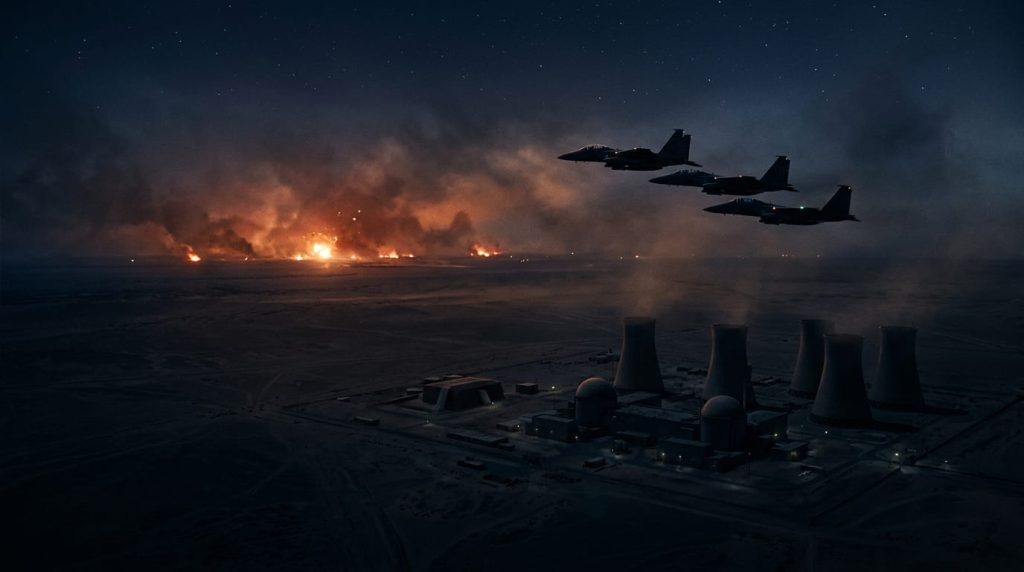
The consequences arrived in June 2025. Israel struck Iranian facilities on June 13, triggering the Twelve-Day War. Iran retaliated. On June 21, U.S. B-2 bombers, F-35s, F-22s, and submarine-launched Tomahawks struck Natanz, Fordow, and Isfahan. A ceasefire followed on June 24. The strikes were tactically impressive.
According to independent assessments, they likely set Iran’s programme back by months, perhaps by two years at most. By 2025, Iran possessed over 6,000 kilograms of enriched uranium, hundreds of kilograms enriched to near weapons-grade levels of 60%, and a breakout time measured in weeks. The strikes addressed the symptoms. They left the strategic logic entirely intact and, as Kenneth Waltz’s work on deterrence theory would predict, almost certainly reinforced Iran’s conviction that nuclear weapons represented its only reliable security guarantee.
What Strategy Actually Requires
The failure of maximum pressure does not argue for passivity in the face of Iranian nuclear ambitions. It argues for something more disciplined and more demanding: a strategy that is multilateral in its enforcement, credible in its diplomatic off-ramps, limited and clear in its objectives, and, above all, grounded in institutions, including the IAEA, capable of providing independent verification. Such an approach is slower, more politically costly, and requires a continuity of commitment across administrations that American political culture finds genuinely difficult to sustain. But it has precedent. The original JCPOA, for all its imperfections, achieved measurable results by exactly these means.
Conclusion
By 2026, the ledger is unambiguous. Iran is closer to nuclear capability than it was in 2015. U.S. alliances have been strained by years of unilateralism. The region has experienced the direct military confrontation that successive administrations had spent decades trying to avoid. Maximum pressure failed not because it was applied too timidly, but because its foundational premises were wrong: that economic pain translates directly into political concession, that unilateral force can substitute for multilateral legitimacy, and that tactical military success constitutes strategic resolution.
The deeper lesson reaches beyond any single administration or any single crisis. Coercion without legitimacy generates resistance. Pressure without a coherent strategy generates escalation. Force without political clarity can destroy infrastructure and demonstrate capability, but it cannot, by itself, resolve the underlying security dilemmas that drive states toward the weapons the force was meant to prevent. Maximum pressure did not simply fail to solve the Iranian nuclear problem. It made the problem substantially worse and, in doing so, offered a case study in how great powers can mistake the tools of strategy for strategy itself.
Leave a Reply