Contents
- 1 In 2025, the Gaza occupation conspiracy unfolds as Trump and Netanyahu push plans of control and displacement.
- 2 The Proposal: From Ceasefire Talk to Full Occupation
- 3 Ethical Collapse and Strategic Miscalculation
- 4 The Power Alliance: Trump and Netanyahu
- 5 Implications: Law, Stability, and Legacy
- 6 Moral and Philosophical Appraisal
- 7 Conclusion: Resistance Must Be Real
In 2025, the Gaza occupation conspiracy unfolds as Trump and Netanyahu push plans of control and displacement.
In early August 2025, Common Dreams published a striking exposé revealing that Israeli Prime Minister Benjamin Netanyahu’s Cabinet is advancing plans for a “complete military occupation of Gaza”, marking the first such move in two decades. The article portrays a turning point: one in which entrenched political interests, military appetites, and geopolitical opportunism align to threaten international law, human dignity, and the very possibility of peace in the Middle East.
The Proposal: From Ceasefire Talk to Full Occupation
What began as tentative ceasefire negotiations between Israel and Hamas has transformed into something darker. The article confirms Netanyahu has formally green-lit a total takeover of Gaza, refusing partial deals and pushing into central refugee zones despite the presence of hostages. At stake is not just territory but millions of lives and a moral abyss.
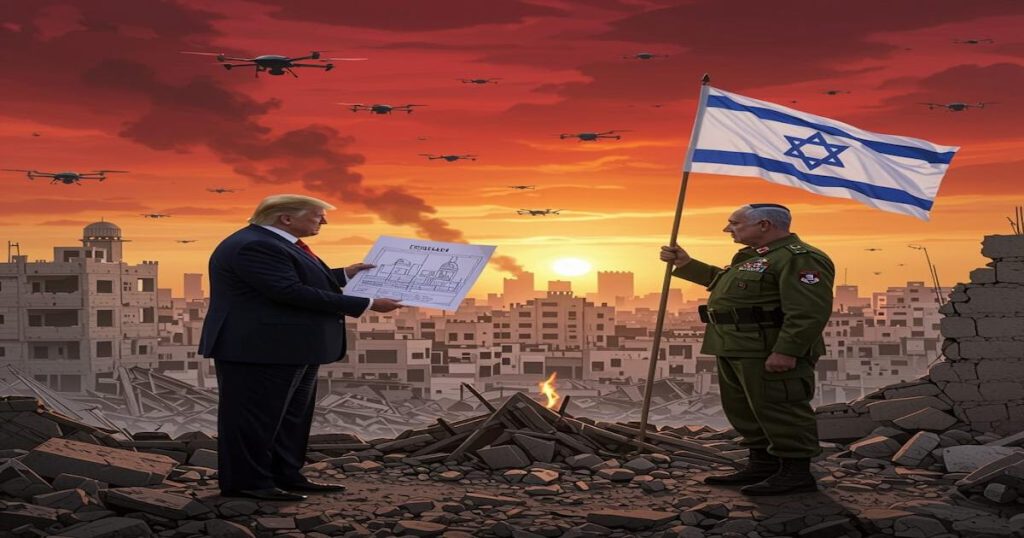
That aim coincides with Donald Trump’s controversial 2025 proposal: the United States would “take over” administrative control of Gaza, redevelop the Strip into a “Riviera of the Middle East,” and displace nearly two million Palestinians into neighbouring countries. Trump described Gaza as a “big real estate site” ripe for redevelopment, suggesting resettlement into nations including Egypt, Jordan, Sudan, Somalia, and Libya. Several countries rejected the plan; however, some regions listened in exchange for recognition or funding.
Though some administration officials later walked back strongly worded statements calling the displacement “temporary”, Trump would not relinquish his territorial rhetoric even as Arab governments resisted and counter-proposal blocs emerged.
Ethical Collapse and Strategic Miscalculation
The proposal’s core elements, forced displacement, seizure of land, and repopulation with “the world’s people”, are textbook ethnic cleansing. Alarmed UN officials condemned the plan as a violation of international law and human rights, warning it would prove catastrophically destabilising.
Human-rights authorities and Arab institutions responded harshly. Amnesty International labelled Trump’s vision as “a war crime,” and the Arab League submitted an alternative plan, rejected by both Washington and Jerusalem, as a peaceful and legitimate counterpoint.
Politically, analysts warn that displacement on this scale could rock states like Jordan and Egypt, with risks of radicalisation, regime crisis, and collapse of peace treaties. Experts argue the moral cost is not hypothetical but real: impending famine, social breakdown, and new fronts of conflict, to say nothing of the ongoing humanitarian carnage inflicted on Gaza’s civilians.
The Power Alliance: Trump and Netanyahu
What makes this episode especially dangerous is the apparent alignment of two populist leaders willing to frame Gaza as both a geopolitical prize and an ideological target. Netanyahu’s confirmation that Israel will pursue complete occupation, bluntly described as a plan to “conquer the Strip”, came despite dissent from Israeli Defence Chief Eyal Zamir, who called the forced resettlement proposal “unworkable”.
Trump’s posture has equally shifted: briefly expressing eyebrow-raising humanitarian empathy on Gaza starvation before fully pivoting toward support for Israel’s maximalist military plans. Observers accuse him of opportunism, lacking a coherent strategy, and fueling escalation while claiming a moral imperative.
Implications: Law, Stability, and Legacy
The article suggests several implications that cannot be ignored:
- Legal collapse: Forcible population transfer is a war crime. A U.S.–Israel alliance pushing this signals abdication of international norms and the empowerment of rule by force.
- Regional destabilisation: Jordan, Egypt, and Gulf nations could find themselves host to massive populations they never consented to; spillover crises are all but guaranteed.
- Undermined U.S. credibility: Global allies opposed the plan, and Arab leaders submitted alternative frameworks, only to be rebuffed. This accentuates diplomatic isolation.
- Humanitarian cataclysm: Gaza remains in collapse, starvation, homelessness, and displacement on a colossal scale, and the plan only deepens this suffering.
- Victimisation of hostages: Israeli captives held by Hamas now face a heightened risk if military operations intensify without negotiation.
Moral and Philosophical Appraisal
Common Dreams frames the episode as a moral nadir, a convergence of war profiteering, ideological fanaticism, and colonial impulse masquerading as reconstruction. It contends that Trump’s and Netanyahu’s schemes are not reforms, but regressions into archaic models of forced displacement and violent coercion.
From a broader vantage point, the episode reflects a more profound philosophical crisis: a rejection of international solidarity, global justice, and ethical restraint. Instead, power politics and populist posturing aim to define Gaza not as a population, but as a commodity to be reshaped by the powerful.
Conclusion: Resistance Must Be Real
The Common Dreams article concludes with urgent warnings: Israel’s escalation is a moral and strategic mistake; Trump’s vision empowers it; and the alternatives coming from Arab leaders, even if modest, are being ignored. More than 600 retired Israeli security officials implored Trump to rein in Netanyahu, warning further violence would achieve nothing positive.
As the world watches the destruction of Gaza unfold not as mere collateral but as an actionable blueprint, it becomes the duty of scholars, activists, and honest voices to resist this trajectory. The inhumanity isn’t abstract; it’s happening, and the plan is shockingly real.
In 2025, Gaza is not a footnote in history; it may define the legacy of U.S. foreign policy, Israeli governance, and the global people’s capacity to respond when power murders accountability.
Leave a Reply