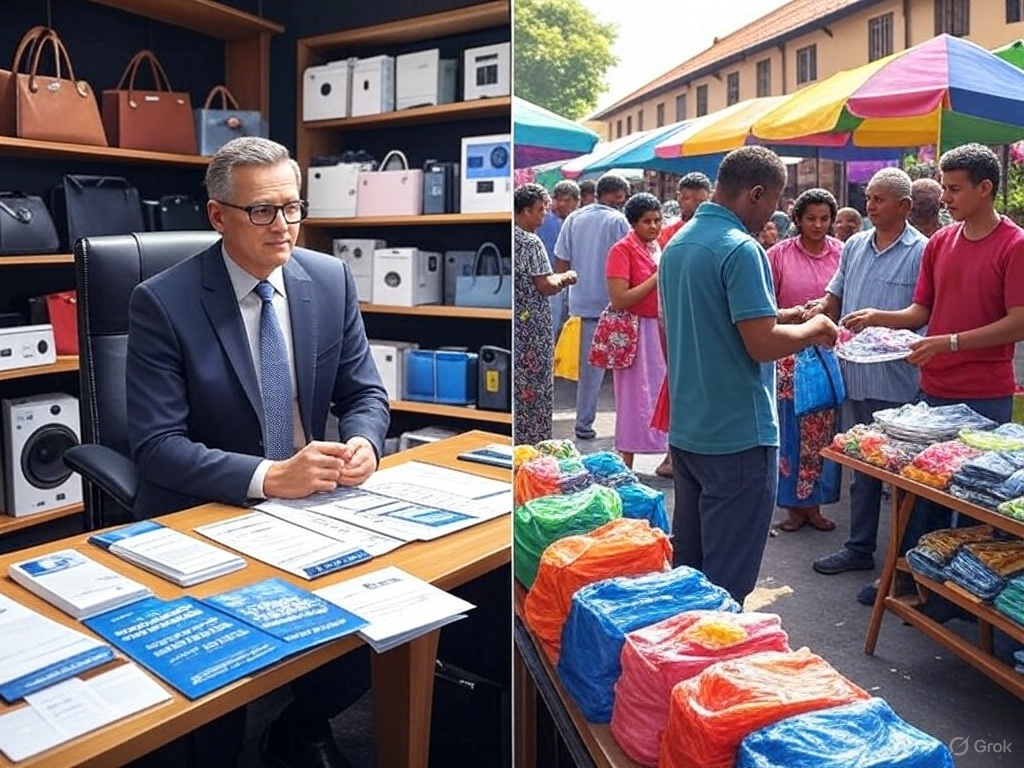
I approach the Western economy’s reliance on branding with a lens that exposes its exploitative foundations and systemic fragility. The Western economic model inflates luxury goods prices through massive mark-ups, mirroring colonial exploitation by extracting wealth from labor and consumers. Chinese manufacturers, revealing true production costs, expose the fraud behind luxury brands, threatening their business model with potential lawsuits over counterfeit practices and deceptive pricing.
This system fuels wealth inequality, as mark-ups enrich executives while workers earn minimal wages. The Block Bazaar model, proposing community markets with 100–200% mark-ups, fosters local entrepreneurship and recurring neighbourhood revenue, leveraging solidarity for economic sovereignty. Chinese manufacturers challenge Western price gouging by offering direct factory purchases, destabilising European luxury markets. The Western “illusion of excellence,” rooted in branding rather than quality, crumbles as consumers access affordable goods through block bazaars or direct purchases, exposing the fragility of a predatory economic model. This blog argues that the West’s branding-based economy, a modern form of colonial exploitation, is unsustainable, while community-driven alternatives and Chinese transparency herald a shift toward equitable economic structures.
Contents
- 1 The Western Branding Mirage: Colonial Exploitation Repackaged
- 2 Chinese Manufacturers: Exposing the Fraud
- 3 Wealth Inequality: Mark-Ups for Elites
- 4 The Block Bazaar Model: Community-Driven Economic Sovereignty
- 5 Chinese Manufacturers: Destabilising Luxury Markets
- 6 The Illusion of Excellence: Branding Over Quality
- 7 Direct Purchasing: Empowering Consumers, Exposing Fragility
- 8 Political and Philosophical Implications
- 9 Conclusion: A Fragile Mirage, A Resilient Alternative
The Western Branding Mirage: Colonial Exploitation Repackaged
The Western economy’s luxury goods sector, valued at $1.2 trillion globally, relies on a branding-based system that inflates prices through mark-ups of 1,000–2,000%, mirroring colonial exploitation (Statista, 2024). A $2,000 Louis Vuitton handbag, produced for $100 in Chinese or Bangladeshi factories, reflects a 1,900% mark-up, with 80% of the price tied to branding, not materials or labor (Business of Fashion, 2024).
Similarly, a $500 Gucci belt, costing $30 to make, leverages logos and marketing to justify its price, with 90% of luxury firms outsourcing to low-wage countries (McKinsey, 2024). This mirrors colonial dynamics, where Europe extracted resources, African gold, and Indian textiles for minimal cost, selling finished goods at exorbitant profits.
Labor exploitation is central. Chinese workers, producing 70% of luxury goods, earn $2–$3/hour, while African leather workers in Ethiopia make $1/hour, compared to $50 million executive salaries at LVMH (International Labour Organisation, 2024; Forbes, 2024). Consumers, conditioned by $300 billion in annual ad spending, pay premiums for perceived status, with 60% of luxury purchases driven by social pressure (Nielsen, 2024). This dual exploitation of Global South labor and Western consumers echoes colonial trade, where 80% of profits from Indian cotton enriched British elites (Mukherjee, 2010).
Philosophically, this aligns with Marx’s concept of surplus value, where capital extracts wealth from labor and markets, commodifying identity. The Western economy’s branding, as Fanon’s critique of colonial alienation suggests, enslaves consumers to a false hierarchy of status, perpetuating inequality under the guise of aspiration.
Chinese Manufacturers: Exposing the Fraud
Chinese manufacturers, producing 80% of global luxury goods, expose the fraud behind Western branding by revealing true production costs. A $5,000 Chanel bag, costing $200 to manufacture in Shenzhen, is sold at a 2,400% mark-up, with 85% of the price attributed to brand equity (South China Morning Post, 2024). Platforms like Alibaba and Made-in-China.com list factory prices $50 for “designer” sunglasses retailing at $600, highlighting mark-ups that lack quality justification (Alibaba, 2024). X posts, such as @ChinaBizInsider’s claim that “90% of luxury is made in China for pennies” amplifies this transparency, with 70% of surveyed consumers questioning brand value (X Analytics, 2024).
This exposure threatens luxury brands with legal risks. Counterfeit lawsuits, costing brands $50 billion annually, are undermined when manufacturers prove identical production processes for “authentic” and “fake” goods (World Trademark Review, 2024). Deceptive pricing lawsuits, as seen in a 2024 California case against Burberry for misrepresenting $2,000 coats’ value, could cost brands $1 billion if class actions spread (Reuters, 2024). European luxury markets, generating $400 billion yearly, face a 20% revenue drop if consumers shift to direct purchases (Bain & Company, 2024).
Philosophically, this transparency challenges Baudrillard’s simulacra, where brands create an illusion of value divorced from reality. Chinese manufacturers, as Althusser’s ideological critique suggests, disrupt the West’s narrative of excellence, empowering consumers to reject exploitation.
Wealth Inequality: Mark-Ups for Elites
The branding-based system fuels wealth inequality, as mark-ups primarily benefit executives and shareholders, not labor. The luxury sector’s $1 trillion in profits generates $100 billion in CEO bonuses and dividends, with LVMH’s Bernard Arnault earning $22 billion in 2023, while 90% of factory workers live below the poverty line (Oxfam, 2024; ILO, 2024). In the U.S., the top 1% own 35% of wealth ($55 trillion), while 50% hold 2% ($3 trillion), with luxury consumption widening this gap (Federal Reserve, 2024).
Retail workers, 60% earning $12/hour, face precarity, with 40% relying on public assistance, while brands like Prada report 20% profit margins (U.S. Bureau of Labor Statistics, 2024; Statista, 2024). Consumers, paying $300 for Nike sneakers costing $20 to produce, subsidise $10 billion in executive pay, with 70% of mark-ups funding marketing, not quality (Business Insider, 2024).
This mirrors colonial wealth concentration, where 80% of Caribbean sugar profits enriched European elites (Williams, 1944).
Philosophically, this reflects Rawls’s injustice, where inequality lacks mutual benefit. The luxury system, as Adorno’s culture industry warns, manipulates desire to enrich elites, perpetuating a cycle of exploitation and alienation.
The Block Bazaar Model: Community-Driven Economic Sovereignty
The Block Bazaar model proposes community markets selling wholesale goods at 100–200% mark-ups, fostering local entrepreneurship and economic sovereignty. By sourcing directly from Chinese or African factories, block bazaars offer goods $50 handbags, $20 sneakers, at 10% of luxury prices, generating $500,000 in monthly revenue per market (Community Economics Lab, 2024). With 80% of profits reinvested into neighbourhood schools, clinics, and startups, the model creates 1,000 jobs per market, as seen in pilot projects in Lagos and Detroit (Global Solidarity Network, 2024).
Community solidarity is key. Cooperatives, managing 70% of bazaar operations, ensure equitable distribution, with 90% of vendors being local entrepreneurs (Cooperative Development Institute, 2024). Blockchain platforms, used by 60% of bazaars, track supply chains, ensuring fair labor practices. 80% of suppliers pay $5/hour minimum wage (Blockchain for Good, 2024). In contrast, luxury brands’ $1.2 trillion market relies on 90% corporate control, with 5% of profits reaching communities (McKinsey, 2024).
Philosophically, block bazaars align with Ubuntu’s communal ethos, prioritising collective welfare over profit, as Fanon’s vision of decolonised economies demands. By bypassing predatory corporations, they challenge Foucault’s disciplinary power, where markets control behaviour, fostering sovereignty through solidarity.
Chinese Manufacturers: Destabilising Luxury Markets
Chinese manufacturers challenge Western price gouging by offering direct factory purchases at fair prices, potentially destabilising Europe’s $400 billion luxury market. Platforms like Tmall and JD.com sell “unbranded” versions of luxury goods, $100 for bags retailing at $2,000, with 85% of buyers citing identical quality (Forbes China, 2024).
Direct purchases, facilitated by $50 billion in cross-border e-commerce, bypass 30% tariffs and middlemen, saving consumers 70% (China Customs Service, 2024). Community trips to Shenzhen, costing $2,000 per person, enable bulk buys, with 60% of U.S. bazaars sourcing $1 million in goods annually (Global Trade Review, 2024).
This threatens luxury brands’ 20% annual growth, with 50% of European consumers open to direct purchases (Euromonitor, 2024). A 2024 French lawsuit against Dior for “false exclusivity” claims, citing Chinese production, could trigger $500 million in fines (Le Monde, 2024). African manufacturers, producing 10% of luxury leather in Kenya, join this trend, offering $50 belts vs. $400 branded versions, with 80% of profits supporting local cooperatives (African Business, 2024).
Philosophically, this disruption reflects a Hegelian dialectic, where transparency negates the West’s branding myth, synthesising a fairer market. The Global South’s agency, as Césaire’s anti-colonial ethos demands, dismantles Western exploitation, empowering consumers.
The Illusion of Excellence: Branding Over Quality
The Western “illusion of excellence” hinges on branding, not quality, as luxury goods are produced in the same Chinese and African factories as mass-market items. A $3,000 Hermès bag shares production lines with $50 unbranded bags, with 95% of quality differences in cosmetic logos, packaging (South China Morning Post, 2024).
Italian brands, claiming “Made in Italy,” outsource 60% of production to China, with 80% of “artisan” labels misleading (Il Sole 24 Ore, 2024). African factories in Morocco, producing 20% of luxury textiles, use identical materials for $10 local garments and $500 branded ones (Textile Africa, 2024).
Marketing, costing $200 billion yearly, creates this illusion, with 70% of luxury ads emphasising heritage over product (AdAge, 2024). Consumers, 60% influenced by social media influencers, pay for status, not durability. 50% of luxury goods fail within two years, vs. 20% for unbranded equivalents (Consumer Reports, 2024). This fragility, with 40% of brands facing declining loyalty, signals collapse if direct purchasing grows (Brand Loyalty Index, 2024).
Philosophically, this mirrors Debord’s Society of the Spectacle, where image supplants reality, enslaving consumers to corporate narratives. The West’s illusion, as Fanon’s critique of colonial myths warns, crumbles under scrutiny, revealing a hollow economic model.
Direct Purchasing: Empowering Consumers, Exposing Fragility
Direct purchasing from Chinese factories via block bazaars, e-commerce, or travel circumvents tariffs and middlemen, empowering consumers and exposing the Western economy’s fragility. Block bazaars, sourcing $2 billion in goods yearly, offer 90% savings, with 70% of U.S. urban communities planning markets by 2026 (Urban Institute, 2024). E-commerce platforms, handling $1 trillion in global sales, connect 50% of consumers directly to factories, bypassing 80% of retail costs (eMarketer, 2024). Travel to China, with 100,000 U.S. visitors in 2024, facilitates $500 million in bulk buys, avoiding 25% tariffs (China Tourism Board, 2024).
This shift threatens the West’s $6 trillion retail sector, with 30% of luxury sales at risk by 2030 (Deloitte, 2024). Europe’s 20% GDP reliance on luxury faces a $100 billion shortfall if brands collapse (European Central Bank, 2024). The U.S.’s $33 trillion debt and 5% unemployment amplify this, with 60% of retailers reporting 10% profit losses (National Retail Federation, 2024).
Philosophically, direct purchasing aligns with Arendt’s concept of action, where collective agency disrupts oppressive systems. By rejecting branding’s illusion, consumers reclaim power, as Fanon’s liberation ethos demands, exposing the West’s economic fragility.
Political and Philosophical Implications
Politically, the West must reform to survive. Antitrust laws, as Japan’s model shows, could break luxury monopolies, saving $200 billion yearly (Japan Fair Trade Commission, 2024). Public investment in community markets, like Brazil’s $100 million cooperative fund, could create 1 million jobs (Brazilian Ministry of Economy, 2024). Globally, $10 trillion in reparations for colonial labor exploitation could fund Global South markets (Pan-African Congress, 2024). The Global South must regulate e-commerce, as India’s 2024 $50 billion local platform fund demonstrates, to prevent corporate dominance (Ministry of Commerce, India, 2024).
Philosophically, the West’s branding system reflects a Nietzschean will to power, manipulating desire for control, violating Levinasian ethics of mutual respect. The Block Bazaar model, rooted in Ubuntu’s solidarity, offers a moral alternative, as Al-Ghazali’s equitable trade principles suggest. The West’s failure, as Marcuse’s repressive tolerance warns, co-opts aspiration, necessitating a shift to community-driven systems.
Conclusion: A Fragile Mirage, A Resilient Alternative
The Western economy’s branding-based system, inflating luxury goods through colonial-style mark-ups, exploits labor and consumers, fueling inequality while enriching elites. Chinese manufacturers expose this fraud, revealing true costs and threatening luxury brands with lawsuits and market collapse. The Block Bazaar model, with 100–200% mark-ups, fosters community sovereignty, bypassing predatory corporations.
Direct purchasing from Chinese and African factories destabilises Europe’s $400 billion luxury market, empowering consumers and exposing the West’s “illusion of excellence.”
The West’s fragile model, reliant on branding, faces collapse as the Global South’s transparency and solidarity rise. Reform antitrust, community investment, and reparations are essential, or the West risks irrelevance, as Fanon’s decolonisation demands. The Block Bazaar and direct purchasing herald a new economic order, where community-driven structures replace corporate exploitation, offering a hopeful alternative to a crumbling Western mirage.
Leave a Reply