Contents
- 1 The Conservative Friends of Israel wield significant influence in Westminster, subtly steering Tory policy and media narratives towards a pro-Israel stance, often overshadowing Palestinian rights and international law
- 2 CFI’s Foundations: A Pro-Israel Powerhouse
- 3 Shaping the Media Narrative
- 4 Moulding Conservative Party Policy
- 5 Defending Israeli Settlements
- 6 The Broader Implications: Democracy Undermined
- 7 A Critical Perspective: The Establishment’s Blind Spot
- 8 Toward Transparency and Accountability
- 9 Conclusion: Clearing the Fog
The Conservative Friends of Israel wield significant influence in Westminster, subtly steering Tory policy and media narratives towards a pro-Israel stance, often overshadowing Palestinian rights and international law
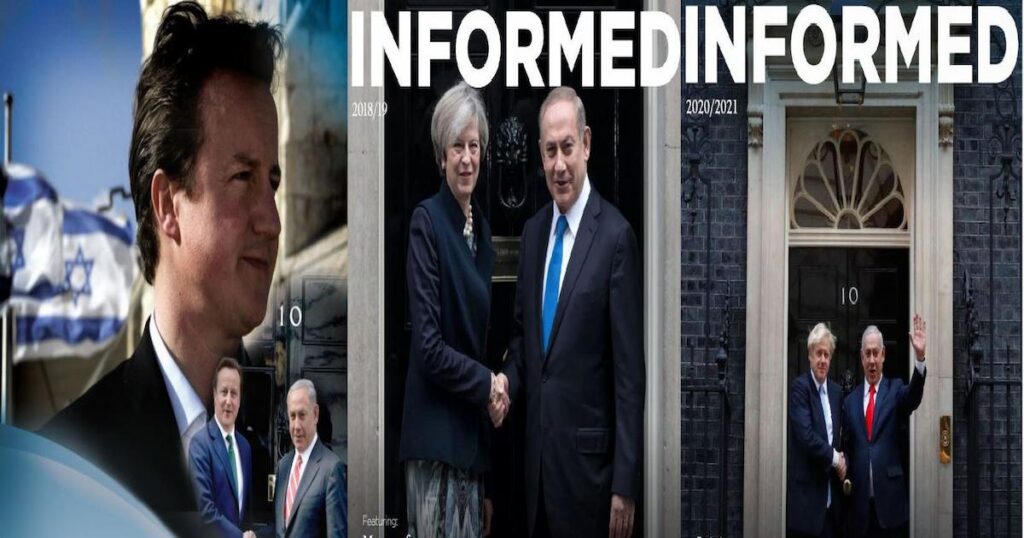
In the corridors of Westminster, where power is brokered and narratives crafted, few lobbying groups wield as much influence with as little scrutiny as the Conservative Friends of Israel (CFI).
Established in 1974, CFI has embedded itself within the Conservative Party, claiming that 80% of Tory MPs are members, underscoring its dominance.
Its mission: to strengthen ties between the UK and Israel, promote the Israeli Likud party’s interests within British Conservatism, and ensure unwavering support for Israel, including its controversial settlement policies in the occupied Palestinian territories.
This blog dissects CFI’s influence on media narratives, party policy, and its role as a defender of Israeli settlements, exposing how a small, well-funded group has shaped British foreign policy to serve a foreign state’s agenda, often at the expense of democratic transparency and Palestinian rights.
CFI’s Foundations: A Pro-Israel Powerhouse
Founded by Tory MP Michael Fidler, CFI emerged during a period when British support for Israel was growing, particularly among the Conservative right, who viewed Israel as a strategic ally against Soviet-aligned Arab states.
By 1995, historian Robert Rhodes James described CFI as “the largest organisation in Western Europe dedicated to the cause of the people of Israel.”
Its current leadership, including Parliamentary Chairman Stephen Crabb and Honorary President Stuart Polak (Lord Polak), has maintained this legacy, cultivating deep ties with Israel’s political, military, and intelligence elites.
CFI’s influence stems from its strategic positioning. Operating as a private company limited by guarantee since 2012, it avoids the transparency required of public organisations.
Its funding remains opaque, though it has received money from entities like the Jewish Agency, a parastatal body tied to the Israeli state.
This secrecy, combined with its access to Tory elites, has led critics like journalist Peter Oborne to call CFI “by far Britain’s most powerful pro-Israel lobbying group.”
Posts on X echo this sentiment, with users like @OborneTweets arguing that CFI resembles a “London outpost for Netanyahu’s far-right extremist Likud coalition.”
Shaping the Media Narrative
CFI’s influence on British media is subtle but pervasive, achieved through strategic trips, relationships with journalists, and coordination with groups like the Britain Israel Communications and Research Centre (BICOM).
Since 2015, CFI has funded 24 delegations to Israel for over 180 Conservatives, including MPs and candidates, costing over £330,000.
These trips, often framed as “fact-finding” missions, expose participants to Israeli perspectives, including visits to the illegal West Bank security wall and meetings with figures like Colonel Dany Tirza, its architect.
Such experiences shape MPs’ views, which they then relay to the public via media appearances and parliamentary debates.
BICOM, closely aligned with CFI through shared donors like Trevor Pears and Poju Zabludowicz, plays a complementary role by briefing journalists and organising their own trips to Israel.
The Guardian has noted that BICOM’s efforts target mainstream outlets, including its own staff, to promote pro-Israel narratives.
This creates a feedback loop: MPs return from CFI trips with pro-Israel talking points, which are amplified by BICOM-influenced media, marginalising Palestinian perspectives.
For instance, CFI’s failure to criticise Israel’s 2018 nation-state law or the 2021 Gaza bombings suggests a deliberate bias toward Netanyahu’s policies, a silence mirrored in much of Britain’s press.
The media’s reluctance to scrutinise CFI is striking.
A 2009 Lexis Nexis search found only 154 mentions of CFI in the British press since 1985, compared to over 1,000 for the Tobacco Manufacturers Association.
This disparity reflects CFI’s low profile, maintained through discreet lobbying and high-level access.
When coverage does occur, it’s often prompted by controversy, like the 2017 Al Jazeera sting revealing Israeli embassy staff discussing “taking down” critics like Alan Duncan, a Tory MP who condemned settlements as “akin to apartheid.”
Yet such stories rarely disrupt the broader pro-Israel narrative, as CFI’s influence ensures sympathetic framing of Israel’s actions, including settlement expansion.
Moulding Conservative Party Policy
CFI’s grip on the Conservative Party is unparalleled. By 2009, Channel 4’s Dispatches reported that half the shadow cabinet were CFI members, a figure likely higher today given the group’s claim of 80% Tory MP membership.
This saturation translates into policy influence, particularly on Middle East issues. CFI’s trips, funded to the tune of £367,000 from 2012-2022, target new MPs like James Cleverly and Suella Braverman, who visited Israel in 2015 shortly after their election.
Both later rose to senior roles, with Cleverley defending Israel’s 2021 Gaza campaign as Middle East minister and Braverman dismissing Israeli war crimes allegations post-2023.
Donations amplify this influence. Dispatches claimed CFI members and their businesses donated over £10 million to the Tories between 2001 and 2009, though CFI disputed this, admitting only £30,000 directly from the group. Key donors like Trevor Pears (£20,000 to David Cameron’s 2005 leadership bid) and Lord Kalms, who threatened to withdraw funding over William Hague’s criticism of Israel’s 2006 Lebanon invasion, wield significant leverage. Often channelled to constituency offices or leadership campaigns, these funds create a culture where pro-Israel stances are rewarded and criticism is punished.
CFI’s policy impact is evident in the Tories’ reluctance to condemn Israeli settlements, deemed illegal under international law.
While Margaret Thatcher supported Israel but criticised its moral lapses, Boris Johnson’s government offered “slavish support” for Netanyahu’s policies, ignoring ethnic cleansing in East Jerusalem and Gaza airstrikes.
CFI’s role in this shift is clear: it never rebukes settlement expansion or Netanyahu’s far-right allies like Itamar Ben-Gvir, a settler convicted of incitement who threatened Yitzhak Rabin before his 1995 assassination.
This silence shapes party policy, ensuring Tory leaders like Johnson and Cameron avoid terms like “disproportionate” when describing Israel’s actions, as seen in Cameron’s 2009 pledge to moderate his language after CFI pressure.
Defending Israeli Settlements
CFI’s support for Israeli settlements is unequivocal, aligning with Likud’s vision of “Israeli sovereignty” from the Jordan River to the Mediterranean.
Settlements, built on occupied Palestinian land, are condemned by the UN and the International Court of Justice (ICJ) as violations of the Fourth Geneva Convention.
Yet CFI’s delegations often include visits to these areas, presenting them as legitimate extensions of Israeli security needs.
MPs like Matthew Offord, who accepted £2,799 from the Jewish National Fund (JNF), a group linked to settlement funding return pledging to “work tirelessly” for Israel’s “right to self-defence.”
This stance dovetails with CFI’s broader defence of Netanyahu’s policies, even as the ICJ warns of potential genocide in Gaza. Posts on X, like @Rachel_442’s, highlight CFI’s refusal to criticise Israel’s actions, noting its alignment with Likud’s far-right agenda.
Former Tory minister Alan Duncan, targeted by CFI for his 2014 condemnation of settlements, accused the group of “interfering at a high level” in British politics, a claim echoed by @AsaWinstanleyon.
CFI’s influence ensures that Tory policy rarely acknowledges the “massive and cruel” land seizures described by Amnesty International, instead framing Israel as a victim of Palestinian aggression.
The Broader Implications: Democracy Undermined
CFI’s influence raises profound questions about British democracy. Its opaque funding, reliance on foreign-linked donors, and ability to shape policy suggest a foreign state Israel holds undue sway over UK politics.
The 2017 Al Jazeera tapes, exposing Israeli embassy staff plotting against MPs like Duncan and Crispin Blunt, revealed CFI’s role as a conduit for such interference.
Former minister Desmond Swayne called for an investigation, but no significant action followed, underscoring CFI’s untouchability.
The media’s complicity, driven by BICOM’s briefings and CFI’s access to elites, stifles debate on Palestine.
Critical voices, like Labour’s Jeremy Corbyn, face marginalisation; his ousting from Labour was partly due to his Palestine advocacy, contrasting with the pro-Israel Labour Friends of Israel (LFI).
Within the Tories, pro-Palestinian sentiment is virtually extinct; the Conservative Friends of Palestine, founded in 2019, claims no parliamentary members.
This imbalance distorts public discourse, presenting Israel’s actions as unassailable while Palestinian suffering is sidelined.
CFI’s defence of settlements also implicates Britain in international law violations.
By cultivating MPs who dismiss ICJ rulings or Gaza casualty figures (over 30,000 by 2024, per the Gaza Health Ministry),
CFI ensures UK policy aligns with Israel’s far-right, not global consensus. This risks complicity in war crimes, as noted by critics like @declassifiedUK, who highlight CFI’s ties to Israel’s military establishment.
A Critical Perspective: The Establishment’s Blind Spot
From an anti-establishment vantage, CFI exemplifies how Western elites prioritise geopolitical alliances over justice.
The group’s influence reflects a broader pattern of Western complicity in Israel’s occupation, rooted in Cold War strategic interests and sustained by lobbying power.
The Tories’ shift from Thatcher’s principled support to Johnson’s uncritical endorsement mirrors the West’s broader alignment with Israel’s rightward drift under Netanyahu, whose coalition includes extremists like Ben-Gvir and Bezalel Smotrich.
This alignment serves elite interests, arms deals, intelligence sharing, and countering Iran while ignoring Palestinian rights.
CFI’s donors, linked to firms like Elbit Systems, profit from Israel’s military-industrial complex, as revealed in 2012 when Elbit’s British chair admitted using CFI to access decision-makers.
Such cronyism thrives in a system where transparency is sacrificed for power, a hallmark of Western foreign policy’s moral bankruptcy.
Toward Transparency and Accountability
Breaking CFI’s stranglehold requires exposing its operations and demanding accountability.
The media must investigate CFI’s funding and influence, amplifying Palestinian voices over BICOM’s spin.
MPs should disclose all CFI-related donations and trips, and parliamentary rules must curb lobbying groups’ access to policy-making.
Public pressure can force a reckoning, as seen in growing X sentiment against CFI’s “genocidal” alignment with Netanyahu.
Ultimately, Britain must realign its Middle East policy with international law, condemning settlements and supporting Palestinian self-determination.
This demands rejecting CFI’s narrative that Israel’s security justifies occupation, a fiction that perpetuates violence and undermines democracy.
As @AaronBastani notes on X, the “massive influence” of a foreign state in British politics is undeniable, yet both major parties remain complicit.
Conclusion: Clearing the Fog
The Conservative Friends of Israel is no mere advocacy group; it’s a powerful lobby that shapes British media, Tory policy, and UK support for Israeli settlements.
Its opaque funding, high-level access, and media coordination ensure Israel’s far-right agenda faces little scrutiny, while Palestinian suffering is erased from mainstream discourse.
This influence, rooted in decades of strategic manoeuvring, exposes the rot at the heart of Western foreign policy: a willingness to sacrifice principle for power.
Unmasking CFI’s role is the first step toward a foreign policy prioritising justice over complicity, transparency over secrecy, and humanity over geopolitics.
Leave a Reply